Have you ever noticed a painful, swollen lump on your skin and wondered whether it’s an abscess or a boil? You’re not alone. Many people confuse abscess vs boil because both involve pus, swelling, redness, and tenderness. They can look similar at first glance and often feel just as uncomfortable.
Although they look/sound similar, they serve completely different purposes.
Understanding the difference between abscess vs boil is important because treatment, severity, and medical risks can vary. While one might heal on its own, the other may require professional drainage or antibiotics. In this complete guide, we’ll break down abscess vs boil in simple, clear language so you know exactly what you’re dealing with — and when to see a doctor.
What Is an Abscess?
An abscess is a pocket of pus that forms inside body tissue due to infection. It can develop almost anywhere — under the skin, in the gums, inside organs, or even deep within muscles.
🔬 Clear Meaning
An abscess forms when your immune system fights bacteria. White blood cells rush to the infected area, leading to inflammation and a buildup of pus (a mix of dead cells, bacteria, and debris).
When discussing abscess vs boil, remember that an abscess is the broader medical term.
📍 Where It Occurs
Abscesses can appear:
- Under the skin
- In the mouth (dental abscess)
- In internal organs
- Around the anus (perianal abscess)
Unlike a boil, an abscess isn’t limited to hair follicles.
🩺 Symptoms
- Swelling
- Redness
- Warmth
- Severe pain
- Fever (in serious cases)
Example sentences:
- “The doctor drained the abscess to relieve the pressure.”
- “She developed a dental abscess after ignoring a cavity.”
📚 Medical Note
Abscesses are often caused by bacteria such as Staphylococcus aureus. In some cases, antibiotic-resistant strains like MRSA may be involved.
Doctors sometimes need to perform a procedure called incision and drainage to treat a large abscess.
When comparing abscess vs boil, an abscess can be deeper and more serious.
What Is a Boil?
A boil (also called a furuncle) is a specific type of skin infection that starts in a hair follicle or oil gland.
🔬 Clear Meaning
A boil is essentially a small, localized abscess that develops on the skin’s surface.
So in the abscess vs boil comparison, you can think of a boil as a type of abscess — but not all abscesses are boils.
📍 Where It Occurs
Boils commonly appear on:
- Face
- Neck
- Armpits
- Buttocks
- Thighs
These areas sweat and experience friction, which encourages bacterial growth.
🩺 Symptoms
- Red, painful bump
- Pus-filled center
- Gradual growth over a few days
- Possible rupture and drainage
Example sentences:
- “He had a painful boil on his neck.”
- “The boil burst and started draining.”
📚 Usage & Medical Note
Boils are usually caused by bacteria like Staphylococcus aureus. Most small boils heal on their own with warm compresses.
However, large or recurring boils may require antibiotics.
In the abscess vs boil discussion, boils are generally less severe and more superficial.
Key Differences Between Abscess vs Boil
Understanding abscess vs boil becomes much easier when you break it down clearly.
🔹 Quick Differences
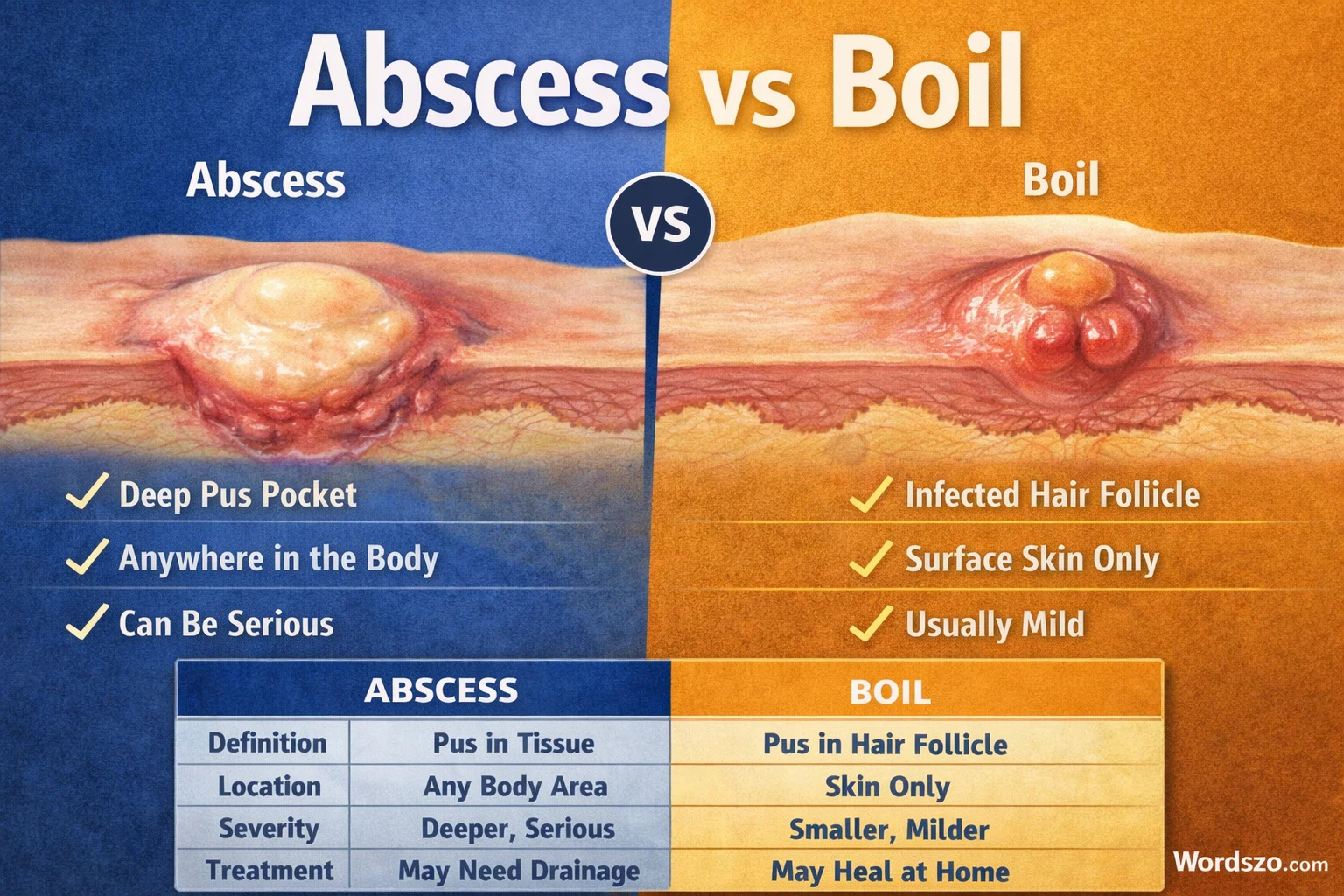
- Definition: All boils are abscesses, but not all abscesses are boils.
- Location: Abscesses can form anywhere; boils form in hair follicles.
- Severity: Abscesses may be deeper and more serious.
- Treatment: Boils often heal naturally; abscesses may need medical drainage.
📊 Abscess vs Boil Comparison Table
| Feature | Abscess | Boil |
|---|---|---|
| Definition | Pocket of pus in tissue | Infection of hair follicle |
| Location | Skin, organs, gums | Skin only |
| Severity | Can be serious | Usually mild |
| Size | Can be large/deep | Typically smaller |
| Treatment | Often requires drainage | May heal with home care |
| Medical Risk | May cause fever/systemic infection | Rarely systemic |
This table simplifies the abscess vs boil distinction clearly.
Real-Life Conversation Examples
🗣 Dialogue 1
Emma: “I have a painful lump on my thigh.”
Jake: “It might be a boil.”
Doctor: “Actually, it’s a deeper abscess.”
🎯 Lesson: Not all skin lumps are simple boils.
🗣 Dialogue 2
Liam: “Can I pop this?”
Nurse: “Don’t pop it. It could be an abscess.”
🎯 Lesson: Improper draining can worsen infection.
🗣 Dialogue 3
Sophia: “My boil keeps coming back.”
Doctor: “We need to test for resistant bacteria.”
🎯 Lesson: Recurring boils may require medical evaluation.
🗣 Dialogue 4
Daniel: “Is a boil the same as an abscess?”
Pharmacist: “A boil is a type of abscess.”
🎯 Lesson: Boils fall under the abscess category.
When to Use Abscess vs Boil
Knowing when to use abscess vs boil depends on context.
✅ Use “Abscess” When:
- The infection is deep
- It affects organs or gums
- A doctor diagnoses it
- Fever or severe symptoms occur
✅ Use “Boil” When:
- The infection starts in a hair follicle
- It’s visible on the skin surface
- It’s small and localized
🧠 Memory Trick
Boil = Hair follicle infection
Abscess = Any pus pocket anywhere
Think:
Boil is a “baby abscess.”
When to See a Doctor
In the abscess vs boil situation, seek medical care if:
- The lump grows larger than 1–2 inches
- You develop fever
- Red streaks appear
- Pain becomes severe
- It doesn’t improve after a few days
Never attempt to squeeze or cut a suspected abscess at home.
Fun Facts
✨ The word “abscess” comes from Latin meaning “to go away,” referring to pus leaving the body.
✨ Boils were once treated with bread poultices before modern antibiotics were available.
Conclusion
The difference between abscess vs boil comes down to depth, severity, and location. A boil is a surface-level infection that begins in a hair follicle. An abscess is a broader term for any pus-filled infection in body tissue, which can sometimes become serious.
Understanding this distinction helps you respond appropriately — whether that means applying a warm compress or seeking medical attention.
Next time someone mixes up these two terms, you’ll know exactly what they mean!