
English spelling can feel tricky, especially when two letter combinations sound exactly the same. “Ch” and “tch” are a perfect example. Both make the /ch/ sound, yet they’re used in very different situations. That’s why learners, writers, and even native speakers often mix them up.
Although they look similar, they serve completely different purposes.
Understanding when to use ch versus tch isn’t about memorization—it’s about spotting patterns. Once you know the rule behind each spelling, choosing the correct one becomes almost automatic. In this guide, we’ll break down what ch and tch mean, where they come from, how they’re used, and how to avoid common mistakes. By the end, you’ll spell words like watch, beach, and kitchen with confidence every time.
What Is “Ch”?
Ch is a common letter combination in English that produces the /ch/ sound, as in chair or chocolate. It appears in words from many origins, including Old English, French, and Greek.
How “Ch” Is Used
- Often appears at the beginning or middle of words
- Common after long vowel sounds or consonants
- Found in many everyday and borrowed words
Examples of “Ch” in Sentences
- She sat on a chair near the window.
- They walked along the beach at sunset.
- He loves dark chocolate.
Usage Note
In words borrowed from Greek, ch may sound like /k/ instead of /ch/ (e.g., chorus, chemistry), which is another reason English spelling feels inconsistent.
What Is “Tch”?
Tch also makes the /ch/ sound, but it follows a much stricter spelling rule. It’s mainly used to protect a short vowel sound before it.
How “Tch” Is Used
- Almost always comes after a short vowel
- Usually appears at the end of a syllable
- Rarely found at the beginning of words
Examples of “Tch” in Sentences
- Don’t forget to watch the movie tonight.
- The baby tried to catch the ball.
- Please switch off the lights.
Usage Note
The “t” in tch helps keep the vowel short. Without it, the word might look like it has a long vowel sound.
Key Differences Between Ch and Tch
| Feature | Ch | Tch |
|---|---|---|
| Sound | /ch/ | /ch/ |
| Vowel before | Long vowel, diphthong, or consonant | Short vowel |
| Word position | Beginning, middle, or end | Usually middle or end |
| Common examples | chair, beach, cheese | catch, watch, kitchen |
Simple Rule to Remember
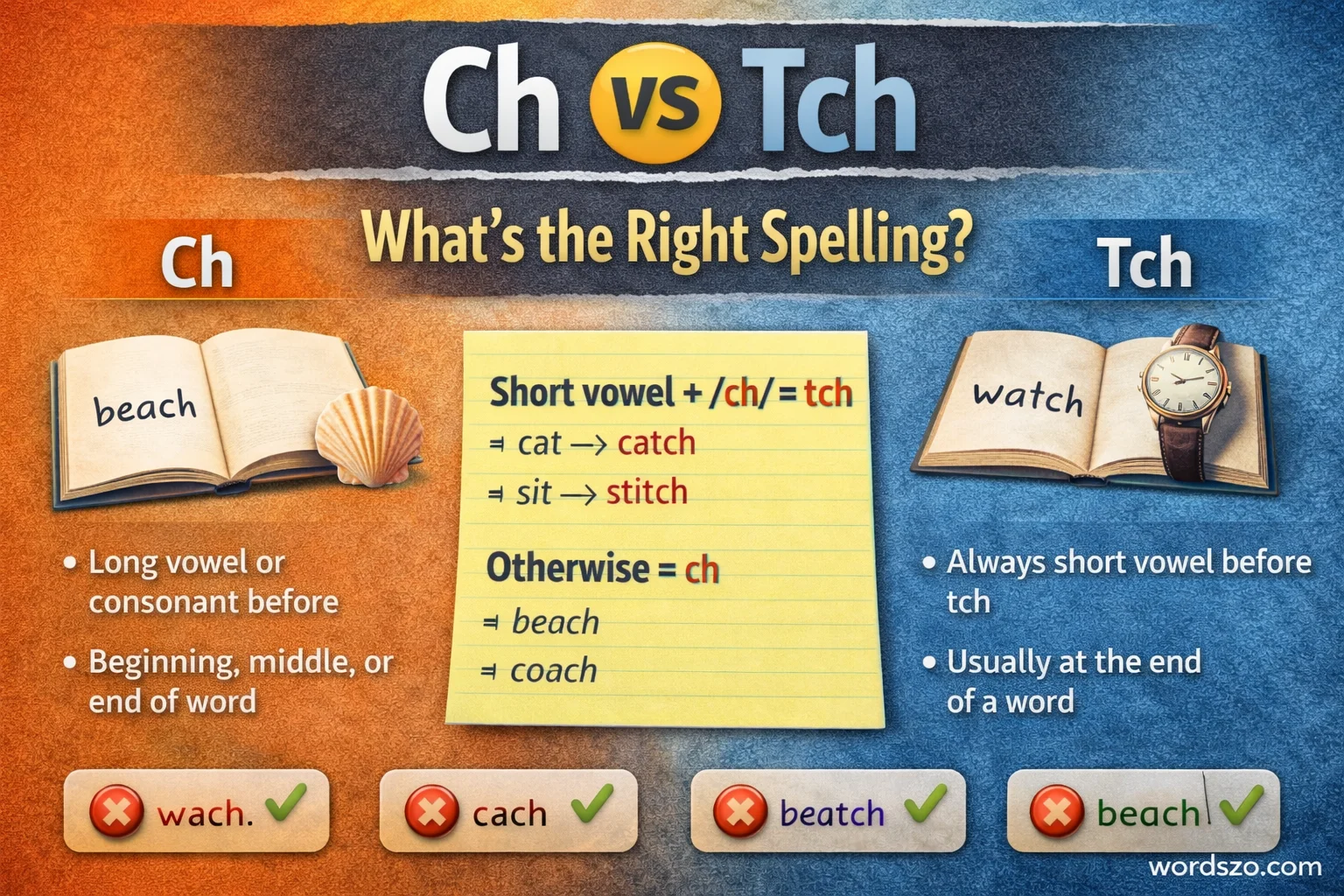
👉 If the /ch/ sound comes right after a short vowel, use “tch.”
👉 In most other cases, use “ch.”
Short vowel + /ch/ = TCH
- cat → catch
- sit → stitch
Not after a short vowel = CH
- beach
- coach
Common Mistakes to Avoid
❌ wach → ✅ watch
❌ cach → ✅ catch
❌ beatch → ✅ beach
A quick vowel check before the /ch/ sound can save you from these errors.
Ch vs Tch in Real-Life Writing
- School & exams: Correct spelling improves grades and clarity
- SEO & content writing: Search engines favor clean, error-free text
- Professional emails: Proper spelling builds credibility
Small spelling choices can make a big difference in how your writing is perceived.
Final Thoughts
The difference between ch and tch isn’t random—it’s rule-based. Once you understand the role of short vowels, spelling these words becomes much easier. “Ch” is flexible and widely used, while “tch” steps in to guard short vowel sounds.
If you ever hesitate, pause and check the vowel before the sound. That one-second check can prevent a spelling mistake and instantly improve your writing confidence.