
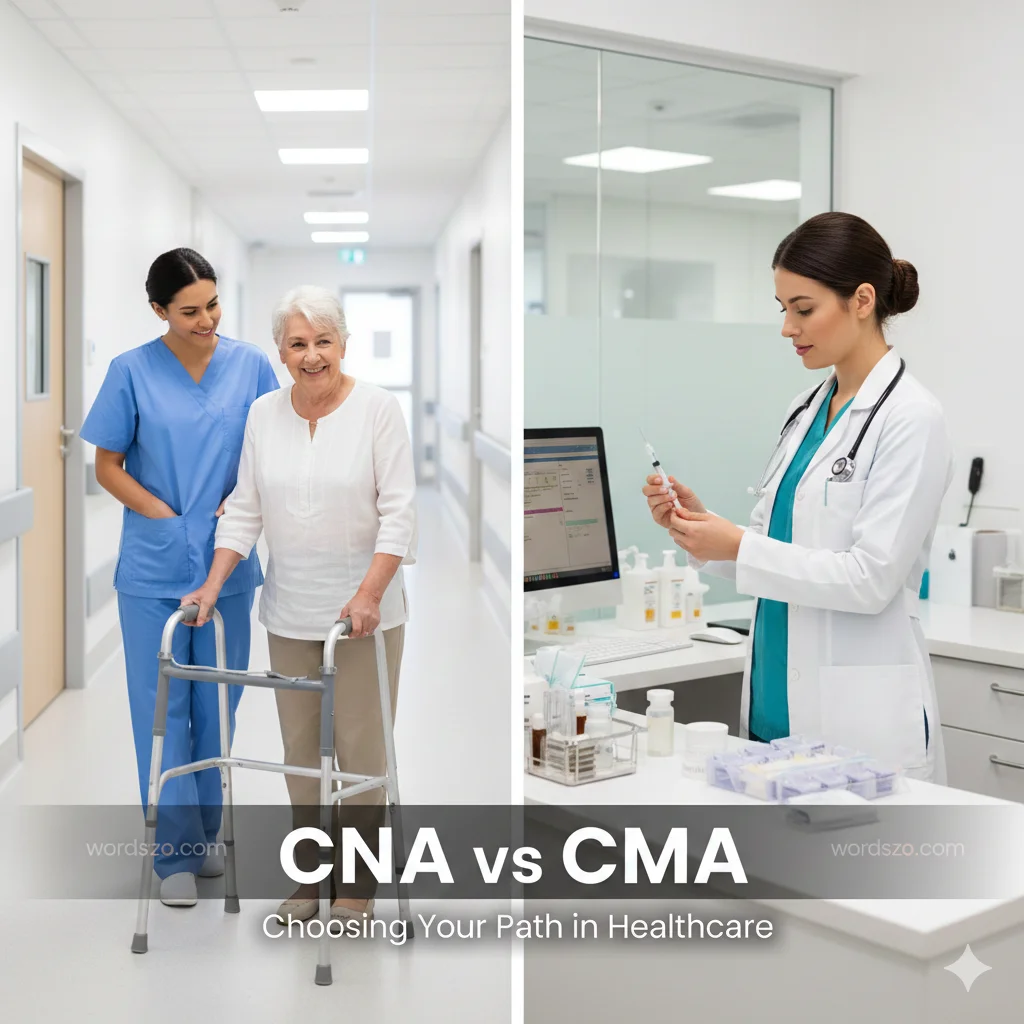
If you’re exploring a career in healthcare, you’ve probably come across the acronyms CNA and CMA. Both roles are vital in the medical field, but they serve different purposes and have distinct responsibilities, education requirements, and career paths. Many aspiring healthcare professionals get confused because both involve patient care, medical knowledge, and healthcare environments.
Although they sound similar, they serve completely different purposes. Understanding the difference between CNA and CMA can help you choose the right career, avoid confusion, and set clear goals for your education and professional development. In this guide, we’ll break down their meanings, duties, education paths, salaries, and career opportunities, helping you make an informed decision.
What Is a CNA?
Meaning:
A CNA (Certified Nursing Assistant) is a healthcare professional who provides basic patient care under the supervision of registered nurses (RNs) or licensed practical nurses (LPNs). CNAs are often the first point of contact for patients, ensuring comfort, safety, and daily care needs.
Where and How CNAs Work:
- Hospitals, nursing homes, long-term care facilities, and home health settings.
- Work is hands-on and involves assisting patients with daily activities such as bathing, feeding, mobility, and monitoring vital signs.
Examples of CNA Duties:
- Helping patients eat, bathe, and dress.
- Taking and recording vital signs.
- Assisting with patient mobility and exercises.
- Reporting changes in patient condition to nurses.
Education and Certification:
- High school diploma or GED required.
- Completion of a state-approved CNA training program (usually 4–12 weeks).
- Pass the CNA competency exam (written and practical).
Short Historical/Usage Note:
CNAs have been integral to patient care for decades, providing essential support in hospitals and care facilities, particularly in long-term patient care.
What Is a CMA?
Meaning:
A CMA (Certified Medical Assistant) is a healthcare professional trained to perform clinical and administrative tasks in outpatient settings, such as clinics, physician offices, and specialty practices. CMAs often have a broader scope than CNAs, combining patient care with administrative responsibilities.
Where and How CMAs Work:
- Clinics, physician offices, outpatient care centers, and hospitals.
- Work involves taking patient histories, preparing patients for exams, administering medications, and managing medical records.
Examples of CMA Duties:
- Measuring vital signs and preparing patients for examinations.
- Assisting physicians during procedures.
- Performing basic laboratory tests.
- Scheduling appointments, updating patient records, and handling billing.
Education and Certification:
- Completion of a medical assisting program (usually 1–2 years) at a community college or vocational school.
- Pass the Certified Medical Assistant exam through AAMA (American Association of Medical Assistants).
- Some states may require additional licensure for specific clinical duties.
Short Historical/Usage Note:
CMAs emerged as healthcare expanded in outpatient settings, bridging the gap between administrative staff and clinical care providers. Their versatile skills make them valuable in fast-paced medical offices.
Key Differences Between CNA and CMA
Here’s a clear comparison to highlight their distinctions:
- Scope of Work: CNAs focus on basic patient care, while CMAs handle clinical and administrative tasks.
- Education: CNAs require a short training program; CMAs require a longer, accredited medical assisting program.
- Certification: CNAs are certified by state exams; CMAs are certified through AAMA or other professional organizations.
- Work Environment: CNAs mainly work in hospitals and long-term care, while CMAs work in outpatient clinics and physician offices.
- Salary: CMAs generally earn higher salaries due to broader responsibilities and additional training.
Comparison Table: CNA vs CMA
| Feature | CNA (Certified Nursing Assistant) | CMA (Certified Medical Assistant) |
|---|---|---|
| Primary Role | Basic patient care | Clinical + administrative tasks |
| Work Environment | Hospitals, nursing homes | Clinics, physician offices |
| Education Required | 4–12 weeks training | 1–2 years medical assisting program |
| Certification | State-approved CNA exam | AAMA or equivalent exam |
| Duties | Bathing, feeding, vital signs | Lab tests, scheduling, assisting doctors |
| Salary | Lower (average ~$30k/year) | Higher (average ~$40–50k/year) |
| Career Growth | Limited | Greater (can specialize, pursue RN/PA) |
Real-Life Conversation Examples
Dialogue 1
A: “I’m thinking about becoming a CNA. How different is it from a CMA?”
B: “A CNA mainly helps patients with daily care, while a CMA also handles clinical and office tasks.”
🎯 Lesson: Scope of work is the key difference.
Dialogue 2
A: “Which one takes less training?”
B: “CNA training is shorter, usually a few weeks, whereas CMA programs take 1–2 years.”
🎯 Lesson: Education requirements differ significantly.
Dialogue 3
A: “Who earns more, CNAs or CMAs?”
B: “CMAs generally earn more due to broader responsibilities.”
🎯 Lesson: Salary reflects training and duties.
Dialogue 4
A: “Where can I work as a CNA?”
B: “Mostly hospitals and nursing homes.”
A: “And CMAs?”
B: “Clinics and outpatient offices.”
🎯 Lesson: Work environments are different.
When to Choose CNA vs CMA
Practical Usage Rules:
- Choose CNA if you want quick entry into healthcare, enjoy hands-on patient care, and are looking for foundational experience.
- Choose CMA if you want broader responsibilities, better pay, and more career growth opportunities.
Memory Trick:
- CNA = Care Needs Assistance → hands-on patient care.
- CMA = Clinical + Management Assistance → clinical + administrative tasks.
Fun Facts & History
- CNA in Pop Culture: CNAs often appear in TV shows and movies as frontline caregivers in hospitals, highlighting their importance.
- CMA Evolution: CMAs evolved from medical secretaries to multi-skilled professionals capable of handling both patient care and office management.
Conclusion
The difference between CNA vs CMA is clear when you focus on scope, education, and responsibilities. CNAs provide essential hands-on care to patients, often serving as the backbone of hospital and long-term care teams. CMAs bridge clinical and administrative roles, offering more opportunities for growth, higher pay, and versatile skills.
Next time someone asks about CNA or CMA, you’ll know exactly which healthcare career path fits your goals!