Introduction
If you’ve ever attended a wedding, prom, or formal event, you’ve probably heard the terms corsage vs boutonniere. At first glance, they may seem confusing—after all, both involve flowers, both are worn on clothing, and both are part of elegant traditions. So it’s easy to mix them up.
Many people wonder: Are they the same thing? Do men and women wear different ones? When should you use each?
Here’s the simple truth: they are not the same.
Although they look/sound similar, they serve completely different purposes. Each has its own style, placement, and role in formal events.
In this guide, you’ll learn exactly what corsage vs boutonniere means, how to use them correctly, and how to avoid common mistakes—whether you’re planning an event or just curious.
What Is “Corsage”?
A corsage is a small arrangement of flowers worn by women during formal occasions.
Meaning of Corsage
The word corsage refers to:
- A decorative floral piece
- Typically worn on the wrist or pinned to clothing
- Often given as a gesture of respect or affection
How It’s Used
In the context of corsage vs boutonniere, a corsage is commonly used for:
- Proms
- Weddings
- Formal parties
- Mother-of-the-bride or groom accessories
Where It’s Used
- Popular in the United States, UK, and globally
- Seen in formal Western traditions
- Common in school dances and ceremonies
Examples in Sentences
- “He gave her a beautiful corsage before prom.”
- “The bride’s mother wore a white rose corsage.”
- “She chose a wrist corsage to match her dress.”
Historical Note
The term corsage comes from the French word cors, meaning “body.” Originally, flowers were pinned to the bodice of a dress, which is how the tradition began.
What Is “Boutonniere”?
A boutonniere is a single flower or small floral decoration worn by men.
Meaning of Boutonniere
The word boutonniere refers to:
- A flower worn on a suit or tuxedo
- Placed in the lapel buttonhole
- Usually simple and elegant
How It’s Used
In the discussion of corsage vs boutonniere, a boutonniere is used for:
- Grooms and groomsmen
- Prom dates
- Formal ceremonies
- Special guests at events
Where It’s Used
- Common in Western formal fashion
- Widely used in weddings and black-tie events
- Seen across the US, UK, and Europe
Examples in Sentences
- “The groom wore a white rose boutonniere.”
- “He pinned the boutonniere to his jacket.”
- “Each groomsman had a matching boutonniere.”
Spelling & Usage Notes
- The word comes from French, meaning “buttonhole”
- It’s always associated with men’s formal wear
- Unlike corsages, it is not worn on the wrist
Key Differences Between Corsage and Boutonniere
Quick Summary
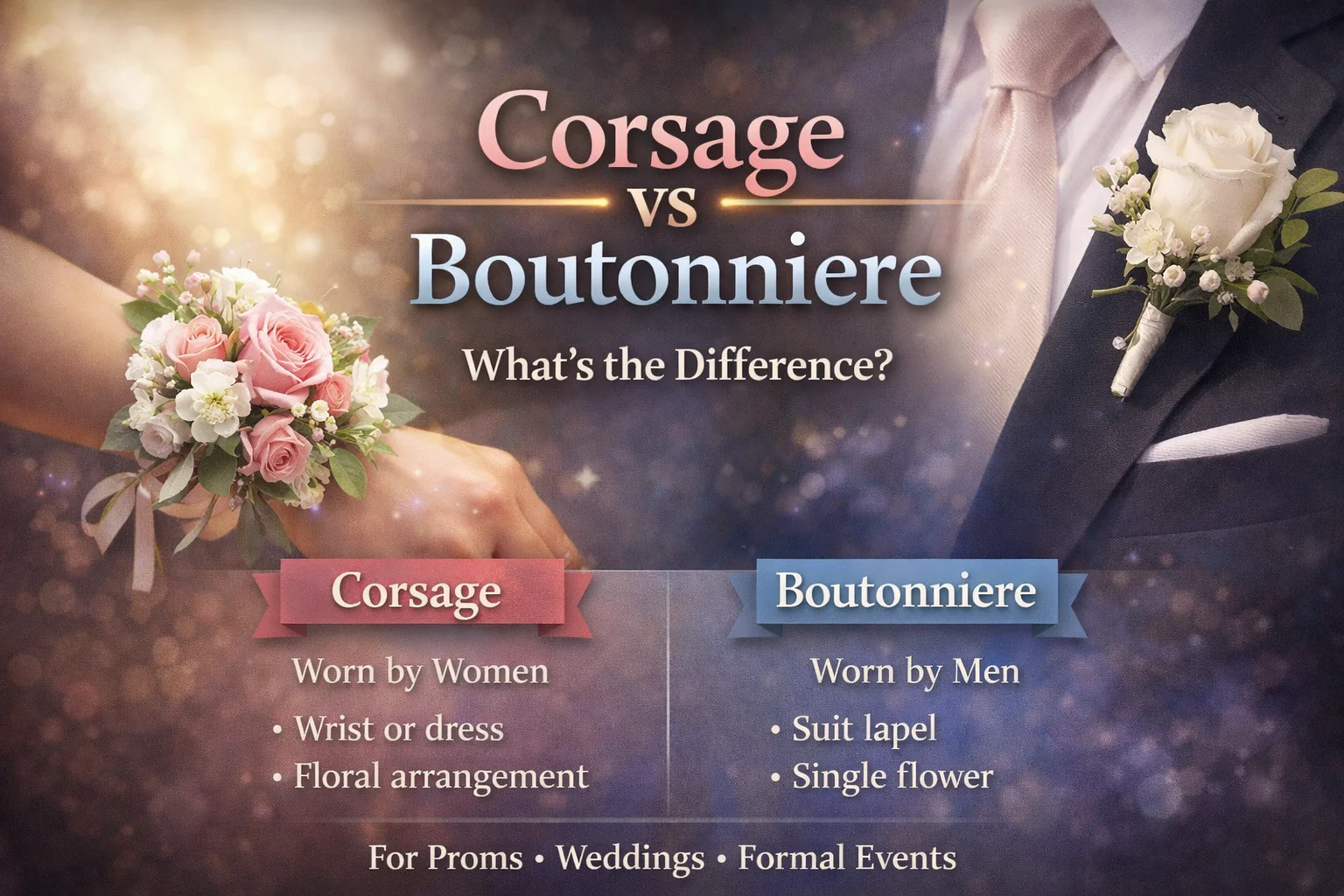
- Corsage = worn by women
- Boutonniere = worn by men
- Corsage = wrist or dress
- Boutonniere = suit lapel
- Corsage = larger arrangement
- Boutonniere = small and minimal
Comparison Table
| Feature | Corsage | Boutonniere |
|---|---|---|
| Worn By | Women | Men |
| Placement | Wrist or dress | Suit lapel |
| Size | Small bouquet | Single flower / tiny arrangement |
| Purpose | Decorative & symbolic | Formal accessory |
| Common Events | Proms, weddings | Weddings, formal events |
| Style | More elaborate | Simple and minimal |
| Origin | French (bodice/body) | French (buttonhole) |
Real-Life Conversation Examples
Dialogue 1
A: “Do I need a corsage for prom?”
B: “Yes, if you’re giving one to your date.”
A: “And what about me?”
B: “You’ll wear a boutonniere.”
🎯 Lesson: Corsage for women, boutonniere for men.
Dialogue 2
A: “Where do I wear this flower?”
B: “If it’s a boutonniere, pin it on your suit.”
A: “Got it!”
🎯 Lesson: Boutonnieres go on lapels.
Dialogue 3
A: “I bought a wrist corsage.”
B: “Perfect for your dress!”
🎯 Lesson: Corsages are worn on the wrist or dress.
Dialogue 4
A: “Can men wear corsages?”
B: “Not usually—they wear boutonnieres instead.”
🎯 Lesson: Each has a traditional gender role.
Dialogue 5
A: “Why are they matching flowers?”
B: “Because corsages and boutonnieres are often coordinated.”
🎯 Lesson: They’re designed to complement each other.
When to Use Corsage vs Boutonniere
Use “Corsage” When:
✔️ You’re referring to a floral accessory for women
✔️ It’s worn on the wrist or dress
✔️ You’re talking about proms or weddings
Examples:
- “She wore a pink corsage.”
- “The florist designed a custom corsage.”
Use “Boutonniere” When:
✔️ You’re referring to a flower for men’s suits
✔️ It’s worn on the lapel
✔️ It’s part of a formal outfit
Examples:
- “His boutonniere matched her corsage.”
- “The groom’s boutonniere stood out.”
Simple Memory Trick
- Corsage = Comes on the wrist
- Boutonniere = Buttonhole flower
US vs UK Usage
There’s no major difference between US and UK usage:
- Both terms are used consistently worldwide
- The traditions are part of Western formal culture
Fun Facts or History
1. Matching Tradition
Corsages and boutonnieres are often matched as a pair, symbolizing connection between partners at events like prom.
2. Wrist Corsages Are Modern
Originally, corsages were pinned to dresses, but wrist versions became popular for convenience and style.
Conclusion
The difference between corsage vs boutonniere is simple once you understand their purpose. A corsage is a floral accessory worn by women, usually on the wrist or dress, while a boutonniere is a single flower worn by men on the lapel.
Both play an important role in formal events and are often designed to complement each other beautifully.
Now that you know the distinction, you can confidently choose the right one for any occasion.
Next time someone uses these two words, you’ll know exactly what they mean!