Introduction
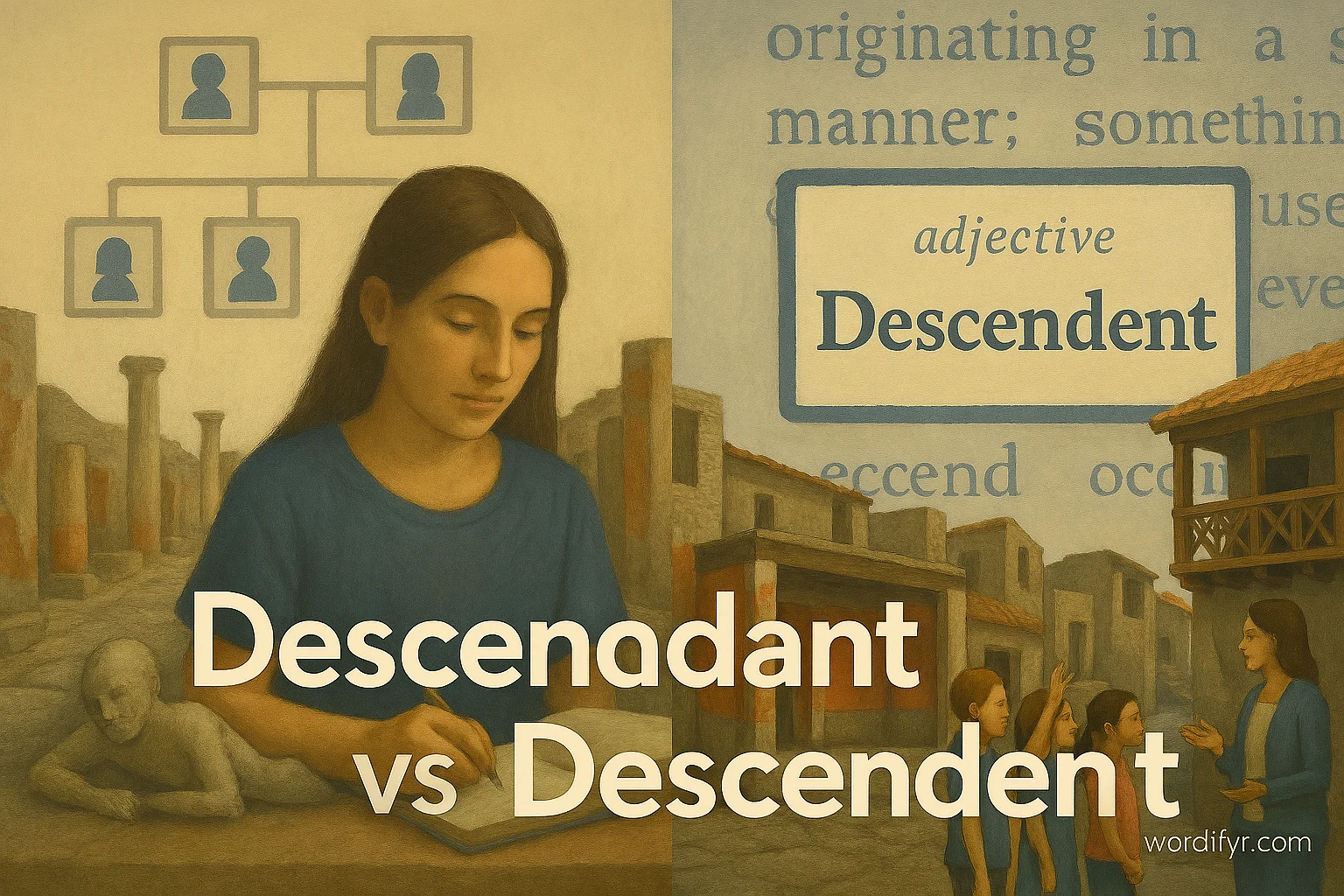
English spelling can be surprisingly confusing, especially when two words look almost identical and seem to mean the same thing. A classic example is descendant vs descendent. You’ll often see both spellings online, in history books, family records, and even academic writing. That naturally raises the question: which one is correct?
The confusion comes from pronunciation (they sound the same) and from English borrowing rules from Latin. Many writers assume one is American English and the other British English—but that’s not actually the case.
Although they look/sound similar, they serve completely different purposes.
In this detailed guide on descendant vs descendent, you’ll learn what each word means, how it’s used, which spelling is preferred, and how to choose the right one with confidence every time.
What Is “Descendant”?
Descendant is the correct and standard noun used to describe a person who comes from a particular ancestor.
Clear Meaning
A descendant is someone who is related to another person through family lineage, such as a child, grandchild, or later generation.
How It’s Used
Descendant is used to:
- Talk about family history
- Describe ancestry and genealogy
- Refer to historical or royal lineages
It is the preferred and accepted form in modern English.
Where It’s Used
Descendant is used consistently across:
- American English
- British English
- Academic writing
- Legal and historical documents
There are no regional spelling differences for this noun.
Examples in Sentences
- “She is a descendant of a famous historical figure.”
- “Many descendants still live in the region.”
- “The museum interviewed descendants of early settlers.”
Short Historical or Usage Note
The word comes from the Latin descendere, meaning “to come down.” Over time, English settled on descendant as the noun form. In the descendant vs descendent discussion, descendant is the form recognized by dictionaries and style guides.
What Is “Descendent”?
Descendent is primarily an adjective, not a noun, although it is sometimes mistakenly used as a noun.
Clear Meaning
As an adjective, descendent means moving downward or descending.
How It’s Used
Descendent is used to describe:
- Motion downward
- Direction or order
- Scientific or technical contexts
It is not the preferred noun for a person related by ancestry.
Where It’s Used
Descendent appears mainly in:
- Scientific writing
- Technical descriptions
- Rare formal contexts
It is uncommon in everyday language.
Examples in Sentences
- “The aircraft followed a descendent path.”
- “The graph shows a descendent trend.”
- “The bird entered a descendent flight pattern.”
Regional or Grammatical Notes
Using descendent to mean a family member is generally considered incorrect or outdated. This is the core distinction in descendant vs descendent.
Key Differences Between Descendant and Descendent
The difference between descendant vs descendent is grammatical, not just stylistic.
Key Difference Summary
- Descendant = noun (a person in a family line)
- Descendent = adjective (moving downward)
- Descendant is the common, correct choice for people
- Descendent is rare and technical
- Most writers only need “descendant”
Comparison Table: Descendant vs Descendent
| Feature | Descendant | Descendent |
|---|---|---|
| Part of Speech | Noun | Adjective |
| Primary Meaning | A person from an ancestor | Moving downward |
| Common Usage | Very common | Rare |
| Used for Family Lineage | Yes | No |
| Preferred in Writing | Yes | No (for ancestry) |
| Dictionary Status | Standard | Limited/technical |
This table clearly explains the descendant vs descendent difference.
Real-Life Conversation Examples
Dialogue 1
A: “Is she a descendant of the king?”
B: “Yes, a direct descendant.”
🎯 Lesson: Use descendant for family relationships.
Dialogue 2
A: “I wrote descendent here—should I change it?”
B: “If you mean ancestry, yes.”
🎯 Lesson: Descendent is not the right noun.
Dialogue 3
A: “Does descendent ever mean a person?”
B: “Technically no, not in modern English.”
🎯 Lesson: Modern usage favors descendant.
Dialogue 4
A: “This graph shows a descendent line.”
B: “That usage is correct.”
🎯 Lesson: Descendent works as an adjective.
Dialogue 5
A: “Why do people confuse these two?”
B: “They sound identical.”
🎯 Lesson: Pronunciation causes confusion.
When to Use Descendant vs Descendent
Knowing when to use each word makes descendant vs descendent easy to master.
Use “Descendant” When:
- Talking about family history
- Writing genealogy or history content
- Referring to people or generations
- Writing academic or professional text
Memory Trick:
ANT = ANCESTOR → descendant
Use “Descendent” When:
- Describing downward motion
- Writing technical or scientific content
- Referring to trends, paths, or direction
Memory Trick:
ENT = trajectory or movement
US vs UK Usage
- Both US and UK English prefer descendant for people
- Descendent remains rare in both regions
This consistency simplifies the descendant vs descendent decision.
Fun Facts or History
1. Most Dictionaries Flag “Descendent” as Rare
Major dictionaries label descendent (noun) as obsolete or uncommon.
2. Family History Software Always Uses “Descendant”
Genealogy tools universally use the noun descendant.
Conclusion
The difference between descendant vs descendent is straightforward once you know the grammar rule. Descendant is the correct noun for a person who comes from an ancestor and is the form you should use in almost all writing. Descendent, on the other hand, is mainly an adjective describing downward movement and is rarely needed outside technical contexts. If you’re writing about people, history, or family lineage, descendant is always the right choice. Next time someone uses these two words, you’ll know exactly what they mean!