
Introduction
If you’ve ever read a prescription label or health article, you’ve probably come across the terms doses vs dosages. At first glance, they seem almost identical—and many people use them interchangeably without thinking twice. After all, both relate to medicine and how much of it you take.
But here’s where the confusion starts.
Are they actually the same? Does it matter which one you use? And why do doctors and pharmacists sometimes prefer one over the other?
Here’s the key takeaway: they are related, but not identical.
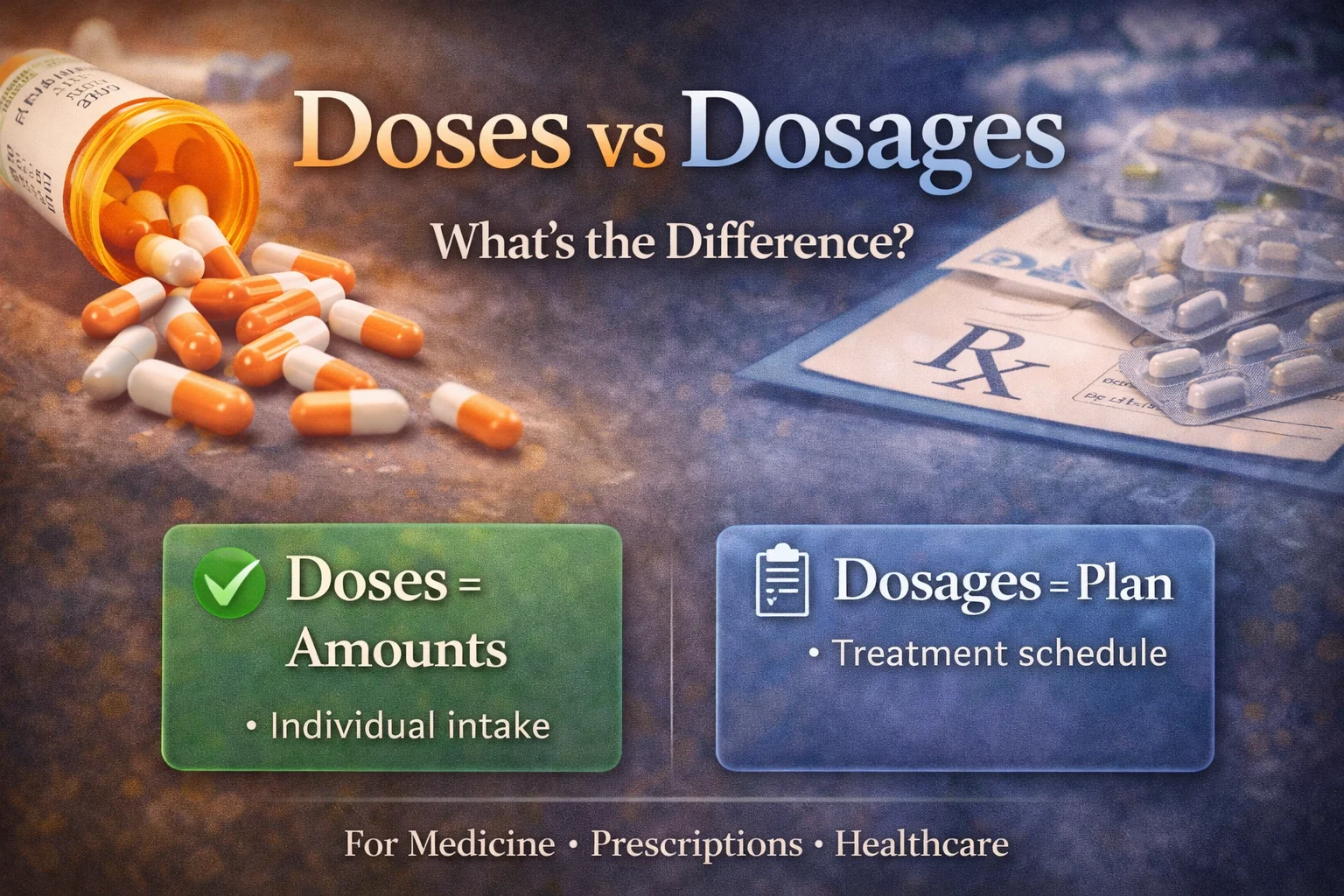
Although they look/sound similar, they serve completely different purposes. One refers to a specific amount taken at a time, while the other describes the overall plan or schedule.
In this guide, we’ll break down doses vs dosages in simple, clear English so you can use each term correctly and confidently.
What Is “Doses”?
The word doses is the plural form of “dose.”
Meaning of Doses
A dose refers to:
- A specific amount of medicine taken at one time
- A single measured quantity
So, doses means multiple individual amounts of medication.
How It’s Used
In the context of doses vs dosages, doses is used when talking about:
- Individual servings of medicine
- Repeated amounts taken over time
- Counting how many times medicine is taken
Where It’s Used
- Medical prescriptions
- Everyday conversations
- Instructions on medicine packaging
- Both US and UK English
Examples in Sentences
- “Take two doses daily.”
- “He missed his morning dose but took the evening dose.”
- “The vaccine requires two doses.”
Historical / Usage Note
The word comes from Greek dosis, meaning “a giving.” It has long been used in medicine to describe measured quantities.
What Is “Dosages”?
The word dosages is the plural form of “dosage.”
Meaning of Dosages
Dosage refers to:
- The overall plan or system of taking medicine
- The amount, frequency, and duration combined
So, dosages means multiple dosage plans or recommendations.
How It’s Used
In the discussion of doses vs dosages, dosages is used when talking about:
- Medical guidelines
- Prescribing instructions
- Different treatment plans
Where It’s Used
- Medical and pharmaceutical contexts
- Doctor prescriptions
- Clinical studies and guidelines
- Formal writing
Examples in Sentences
- “Different patients require different dosages.”
- “The doctor adjusted the dosage.”
- “Recommended dosages vary by age and weight.”
Spelling & Usage Notes
- Dose = one amount
- Dosage = full plan (amount + timing + frequency)
- Both are correct but used in different contexts
Key Differences Between Doses and Dosages
Quick Summary
- Doses = individual amounts
- Dosages = overall plan or schedule
- Doses = countable units
- Dosages = structured guidelines
Comparison Table
| Feature | Doses | Dosages |
|---|---|---|
| Meaning | Individual amounts of medicine | Overall medication plan |
| Focus | Quantity per intake | Amount + frequency + duration |
| Usage | Everyday & medical | Medical & formal |
| Example | “Take 2 doses daily” | “Follow the prescribed dosage” |
| Type | Plural noun (of dose) | Plural noun (of dosage) |
| Context | Specific intake | Full treatment instructions |
Real-Life Conversation Examples
Dialogue 1
A: “How many doses should I take?”
B: “Two doses per day.”
🎯 Lesson: Use “doses” for countable amounts.
Dialogue 2
A: “What’s the correct dosage?”
B: “It depends on your weight and condition.”
🎯 Lesson: Use “dosage” for overall plans.
Dialogue 3
A: “I missed one of my doses.”
B: “Try not to skip them.”
🎯 Lesson: Doses = individual intake.
Dialogue 4
A: “The doctor changed my dosage.”
B: “That means your schedule or amount changed.”
🎯 Lesson: Dosage includes timing and quantity.
Dialogue 5
A: “Are doses and dosages the same?”
B: “Not exactly—one is the amount, the other is the plan.”
🎯 Lesson: Understand the difference clearly.
When to Use Doses vs Dosages
Use “Doses” When:
✔️ You’re talking about specific amounts taken
✔️ You can count them
✔️ You’re giving simple instructions
Examples:
- “Take three doses daily.”
- “He missed two doses.”
Use “Dosages” When:
✔️ You’re referring to a treatment plan
✔️ You’re discussing medical recommendations
✔️ You’re writing in a formal or clinical context
Examples:
- “Different dosages are prescribed for children.”
- “The correct dosage is essential.”
Simple Memory Trick
- Dose = One time
- Dosage = Overall system
Or:
👉 “S” in doses = several amounts
👉 “AGE” in dosage = bigger picture
US vs UK Usage
There’s no major difference:
- Both terms are used globally
- The distinction between doses vs dosages remains the same in all English varieties
Fun Facts or History
1. Medical Precision Matters
In healthcare, confusing doses vs dosages can lead to serious errors. That’s why professionals use these terms very carefully.
2. Everyday vs Technical Language
People often say “dosage” casually, but doctors are precise—using dose for exact amounts and dosage for full instructions.
Conclusion
The difference between doses vs dosages comes down to specific vs overall. Doses refer to individual amounts of medicine taken at a time, while dosages describe the complete plan—including how much, how often, and how long.
Both terms are important, especially in medical contexts, where clarity can make a big difference.
Now that you understand how they work, you can use each one correctly in both everyday and professional situations.
Next time someone uses these two words, you’ll know exactly what they mean!