Introduction
English has a funny way of turning tiny words into big confusion. One classic example is eke vs eek. They’re short, they sound almost the same when spoken quickly, and they often appear in emotional or dramatic sentences. That’s exactly why people mix them up so often — even confident English speakers and writers.
You might see someone write “She tried to eek out a living” or “Eke! That scared me!” and pause for a second, wondering if it looks right. Spoiler alert: it doesn’t.
Although they look/sound similar, they serve completely different purposes.
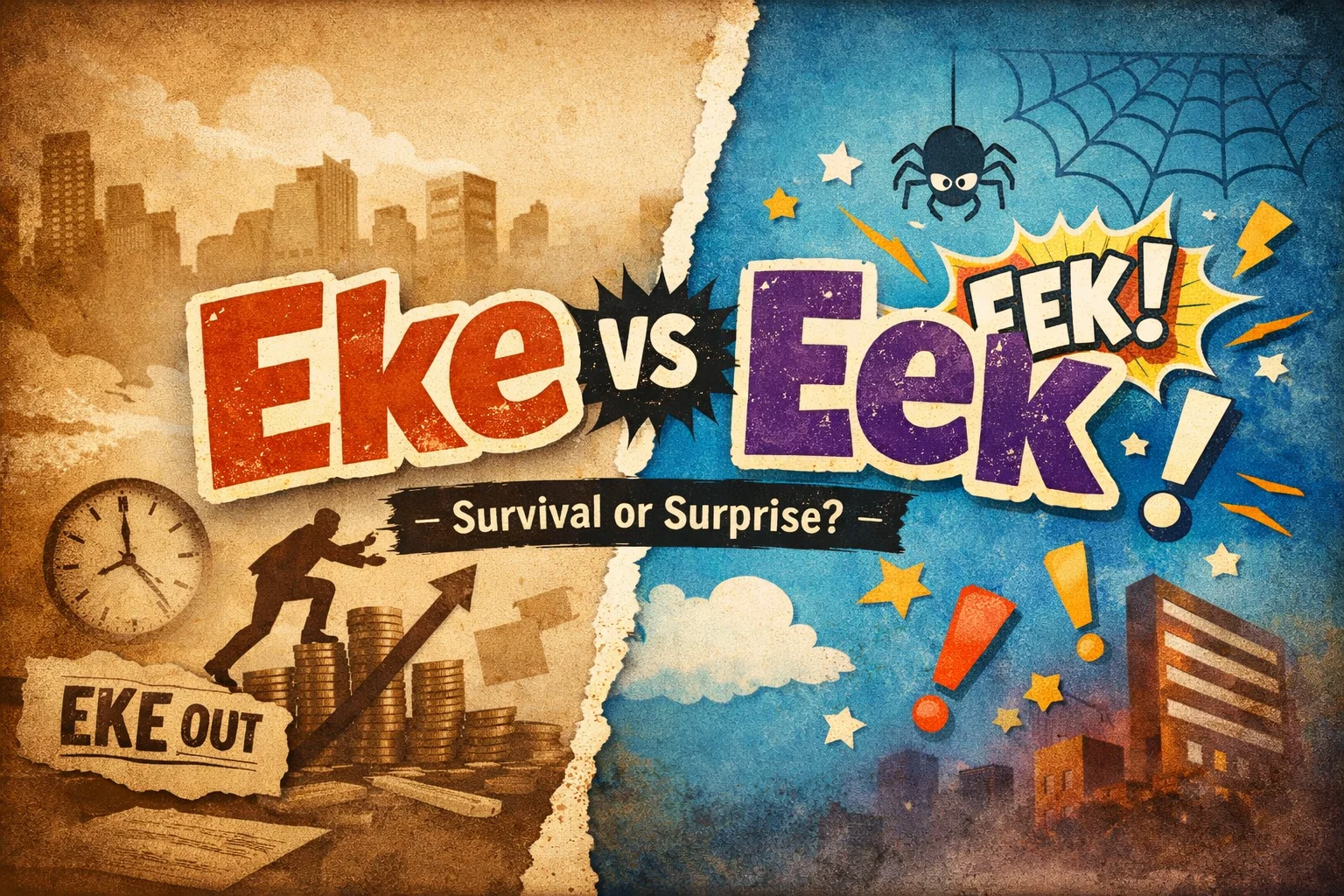
One word is about surviving with difficulty, while the other expresses sudden emotion or surprise. In this complete guide, we’ll break down eke vs eek in the simplest way possible, with examples, dialogues, memory tricks, and a clean comparison table — so you never confuse them again.
What Is “Eke”?
Meaning of Eke
Eke is a verb that means to manage, obtain, or make something last with difficulty, often when resources are limited. It’s commonly used with the word “out”, forming the phrase “eke out.”
In simple terms, eke is about stretching something small so it lasts longer.
How “Eke” Is Used
You’ll almost always see eke in practical or serious contexts, such as:
- Money
- Food
- Time
- Resources
- Survival situations
It focuses on effort, scarcity, and careful management.
Where “Eke” Is Used
- Used in both British and American English
- Common in formal writing, journalism, and storytelling
- Grammatically functions only as a verb
Examples of “Eke” in Sentences
- They managed to eke out a living despite low wages.
- She tried to eke out the remaining food until payday.
- The company eked out profits during the recession.
- He eked out enough time to finish the project.
👉 Notice how eke vs eek already becomes clearer here — eke is never emotional.
Short Historical Note
The word eke comes from Old English “ēcan,” meaning to increase or add. Over time, its meaning shifted from adding more to making limited things last. This evolution explains why eke out is still the most common form today.
What Is “Eek”?
Meaning of Eek
Eek is an interjection, not a verb or noun. It’s used to express sudden fear, surprise, shock, or excitement.
Think of eek as a sound, not an action.
How “Eek” Is Used
You use eek when reacting emotionally to something unexpected:
- A spider
- A loud noise
- A jump scare
- Sudden embarrassment
- Playful surprise
It often appears with an exclamation mark (!).
Where “Eek” Is Used
- Common in spoken English
- Frequently seen in:
- Comics
- Fiction
- Text messages
- Informal writing
- Used in both US and UK English
Examples of “Eek” in Sentences
- “Eek! There’s a mouse in the kitchen!”
- She screamed, “Eek!” when the lights went out.
- Eek, I almost sent that email to the wrong person.
- “Eek!” he said jokingly after the jump scare.
👉 This is where eke vs eek becomes obvious: eek expresses emotion, not effort.
Spelling & Usage Note
- Eek is often italicized or followed by punctuation
- It never changes form
- It does not take tense, plural, or modifiers
Key Differences Between Eke and Eek
Quick Bullet-Point Summary
- Eke is a verb; eek is an interjection
- Eke relates to scarcity and effort
- Eek expresses emotion or surprise
- Eke is often used with “out”
- Eek is usually followed by !
- Mixing them up completely changes the meaning
Comparison Table: Eke vs Eek
| Feature | Eke | Eek |
|---|---|---|
| Part of Speech | Verb | Interjection |
| Meaning | To manage or survive with difficulty | Expression of fear or surprise |
| Emotional or Practical | Practical | Emotional |
| Common Phrase | “Eke out” | “Eek!” |
| Used in US & UK | Yes | Yes |
| Example | Eke out a living | Eek! A spider! |
| Changes Form | Yes (eked, eking) | No |
Real-Life Conversation Examples
Dialogue 1
A: “I had to eek out my savings last year.”
B: “Do you mean eke out?”
A: “Oh wow, yes — wrong word.”
🎯 Lesson: Use eke when talking about money or survival.
Dialogue 2
A: “Eke! That dog scared me!”
B: “Haha, that’s the right eek!”
🎯 Lesson: Eek expresses sudden fear or surprise.
Dialogue 3
A: “She eeked out enough food for the week.”
B: “Perfect usage.”
🎯 Lesson: Eke vs eek — effort always means eke.
Dialogue 4
A: “Eek out a living sounds emotional.”
B: “Nope, it’s practical — not emotional.”
🎯 Lesson: Don’t let pronunciation confuse meaning.
Dialogue 5
A: “I wrote ‘eek out profits’ in my article.”
B: “That changes the meaning completely.”
🎯 Lesson: Small spelling errors can hurt credibility.
When to Use Eke vs Eek
Use “Eke” When:
✔️ Talking about limited resources
✔️ Describing survival or struggle
✔️ Writing formal, academic, or professional content
✔️ Using phrases like eke out a living
Examples:
- They eked out an existence.
- She eked out her savings.
- The team eked out a narrow victory.
Use “Eek” When:
✔️ Reacting emotionally
✔️ Expressing fear, shock, or playful surprise
✔️ Writing dialogue or informal content
✔️ Using exclamations
Examples:
- Eek! That was close.
- Eek, I forgot my password.
- “Eek!” she laughed.
Simple Memory Tricks
🧠 EKE = Effort, Keeping things going
🧠 EEK = Emotion, Exclamation
If it’s about survival → EKE
If it’s about surprise → EEK
US vs UK Usage
There is no regional difference for eke vs eek. Both words mean the same thing in American and British English, making correct spelling even more important.
Fun Facts & History
1. “Eke Out” Is Much Older Than You Think
The phrase eke out dates back to the 14th century, originally meaning to increase. Over time, it evolved to mean making the most of very little.
2. “Eek” Became Popular Through Comics
Eek gained popularity through early comic strips and cartoons, where exaggerated expressions of fear were written phonetically.
Conclusion
The confusion between eke vs eek may seem small, but the meanings couldn’t be more different. Eke is a hardworking verb used for managing scarcity and survival, often appearing as eke out. Eek, on the other hand, is a lively interjection that captures surprise, fear, or excitement in the moment. Mixing them up can completely change the tone of a sentence — especially in professional writing. Once you remember that eke is effort and eek is emotion, the choice becomes effortless.
Next time someone uses these two words, you’ll know exactly what they mean!