Introduction
If you’ve ever had heart tests done, you’ve probably heard of an EKG and an echocardiogram. At first, they can sound confusing—especially since both are used to check your heart and are often ordered together by doctors.
Many people assume they’re the same test or interchangeable, but that’s not true at all.
Here’s the key point: although both tests examine the heart, they do it in completely different ways.
Although they look/sound similar, they serve completely different purposes.
In this guide, we’ll break down EKG vs echocardiogram in simple, easy-to-understand language—so you’ll know exactly what each test does, when it’s used, and how they differ.
What Is “EKG”?
An EKG, also called an Electrocardiogram, is a test that measures the electrical activity of your heart.
Meaning
➡️ EKG = a test that records the heart’s electrical signals to check rhythm and function.
How It’s Used
Doctors use an EKG to:
- Detect irregular heartbeats (arrhythmias)
- Identify signs of a heart attack
- Monitor heart health over time
- Check how well heart medications are working
Where It’s Used
- Hospitals and clinics worldwide
- Emergency rooms
- Routine health checkups
Examples in Sentences
- “The doctor ordered an EKG to check my heart rhythm.”
- “My EKG results came back normal.”
- “They performed an EKG in the emergency room.”
Short Historical Note
The electrocardiogram was invented in the early 1900s and revolutionized heart diagnostics by allowing doctors to see electrical patterns of the heart in real time.
In EKG vs echocardiogram, the EKG focuses on electrical activity, not structure.
What Is “Echocardiogram”?
An echocardiogram is an imaging test that uses ultrasound to create pictures of the heart.
Meaning
➡️ Echocardiogram = a test that shows the heart’s structure and movement using sound waves.
How It’s Used
Doctors use an echocardiogram to:
- View heart chambers and valves
- Check blood flow
- Detect structural problems
- Diagnose conditions like heart valve disease
Where It’s Used
- Hospitals and diagnostic centers
- Cardiology clinics
- Specialized heart exams
Examples in Sentences
- “I had an echocardiogram to check my heart valves.”
- “The echocardiogram showed normal blood flow.”
- “Doctors use echocardiograms to detect structural issues.”
Short Historical Note
Echocardiography became widely used in the mid-20th century and remains one of the most important imaging tools in cardiology.
In EKG vs echocardiogram, the echocardiogram focuses on structure and movement, not electrical signals.
Key Differences Between EKG and Echocardiogram
🔑 Quick Differences
- EKG = electrical signals
- Echocardiogram = images of the heart
- EKG is quick and simple
- Echocardiogram is more detailed
- EKG detects rhythm issues
- Echocardiogram shows physical structure
- EKG uses electrodes
- Echocardiogram uses ultrasound
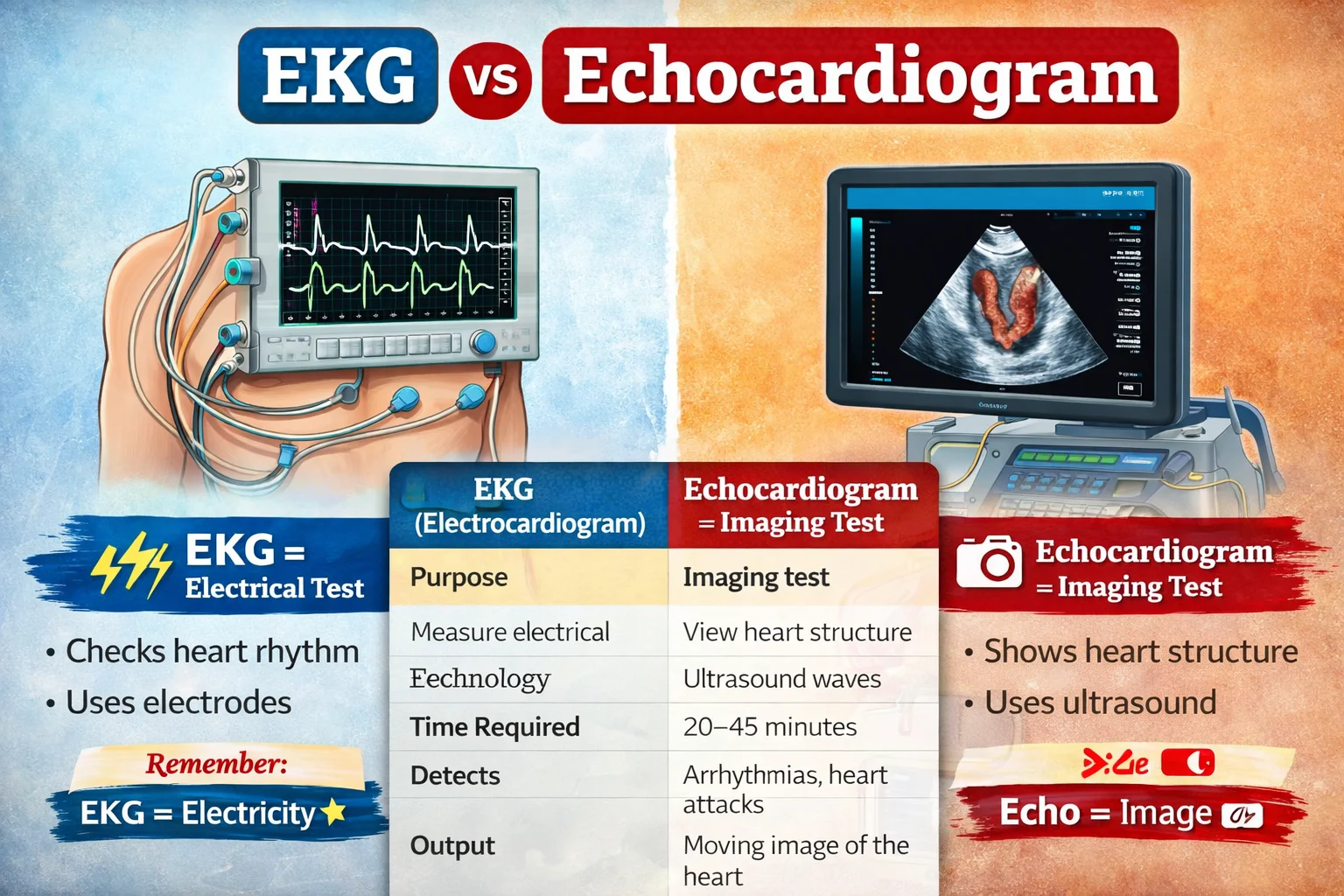
📊 Comparison Table
| Feature | EKG (Electrocardiogram) | Echocardiogram |
|---|---|---|
| Type | Electrical test | Imaging test |
| Purpose | Measure heart rhythm | View heart structure |
| Technology | Electrodes on skin | Ultrasound waves |
| Time Required | 5–10 minutes | 20–45 minutes |
| Detects | Arrhythmias, heart attacks | Valve issues, structural problems |
| Pain Level | Painless | Painless |
| Detail Level | Basic | Detailed |
| Output | Graph (wave patterns) | Moving images (video) |
Real-Life Conversation Examples
Dialogue 1
A: “My doctor ordered an EKG.”
B: “That checks your heart rhythm, right?”
🎯 Lesson: EKG measures electrical activity.
Dialogue 2
A: “I had an echocardiogram today.”
B: “That’s the one with ultrasound images?”
🎯 Lesson: Echocardiogram shows heart structure.
Dialogue 3
A: “Why did I need both tests?”
B: “They check different aspects of your heart.”
🎯 Lesson: Both tests complement each other.
Dialogue 4
A: “Is an EKG enough?”
B: “Not if your doctor needs detailed images.”
🎯 Lesson: EKG is basic; echo is more detailed.
Dialogue 5
A: “Which test takes longer?”
B: “The echocardiogram.”
🎯 Lesson: Echo takes more time than EKG.
When to Use EKG vs Echocardiogram
Understanding EKG vs echocardiogram depends on what your doctor needs to check.
✅ Use “EKG” When:
- Checking heart rhythm
- Detecting arrhythmias
- Quick screening is needed
- Monitoring ongoing heart conditions
Example:
- “The EKG showed an irregular heartbeat.”
✅ Use “Echocardiogram” When:
- Examining heart structure
- Checking valves and chambers
- Investigating symptoms like shortness of breath
- Diagnosing structural heart diseases
Example:
- “The echocardiogram revealed a valve issue.”
🧠 Simple Memory Trick
- EKG = Electricity ⚡
- Echo = Image 📷
This makes EKG vs echocardiogram easy to remember!
🌍 Regional Notes
- “EKG” is commonly used in the US (from German “Elektrokardiogramm”)
- “ECG” is used in many other countries
- “Echocardiogram” is universally used
Fun Facts & Insights
❤️ 1. Both Tests Are Non-Invasive
Neither test requires surgery or needles—they’re completely safe and painless.
🔬 2. Often Used Together
Doctors frequently order both tests to get a complete picture of heart health—electrical + structural.
Conclusion
The difference between EKG vs echocardiogram comes down to function vs structure. An EKG measures the electrical activity of your heart, helping detect rhythm problems quickly. An echocardiogram, on the other hand, creates detailed images of your heart, showing how it looks and functions physically.
Both tests are essential, safe, and often used together to provide a complete understanding of heart health.
Next time someone mentions these two tests, you’ll know exactly what they mean!