Introduction
Names can be surprisingly tricky, especially when they look almost identical. One of the most commonly confused name pairs is Elliot vs Elliott. You may have seen both spellings used for first names, last names, characters in movies, or even brand names—and wondered which one is correct. The confusion grows because both versions are legitimate, widely used, and pronounced exactly the same.
People often assume one spelling is American and the other British, or that one is a mistake. In reality, the difference is far more subtle and rooted in naming conventions, family history, and personal preference rather than strict grammar rules.
Although they look/sound similar, they serve completely different purposes.
In this guide, we’ll clearly explain Elliot vs Elliott, explore their origins, usage, popularity, real-life examples, and help you decide which spelling is right for your situation.
What Is “Elliot”?
Meaning of Elliot
Elliot is a proper noun used as both a first name and a surname. It is a spelling variant of the traditional name Elliott and carries the same meaning.
The name ultimately traces back to the Hebrew name Elijah, meaning “My God is Yahweh.”
How “Elliot” Is Used
- Commonly used as a first name
- Occasionally used as a last name
- Popular in modern, minimalist naming trends
This spelling is often chosen for its cleaner and simpler appearance.
Where “Elliot” Is Used
- United States
- United Kingdom
- Canada
- Australia
There are no grammatical rules that limit the use of Elliot. It is entirely acceptable in all English-speaking countries.
Examples of “Elliot” in Sentences
- “Elliot is starting a new job this Monday.”
- “The novel was written by Elliot Parker.”
- “They named their son Elliot because they preferred the simpler spelling.”
Usage Note
The single-T Elliot spelling is often perceived as modern, streamlined, and contemporary, which makes it popular among parents choosing baby names today.
What Is “Elliott”?
Meaning of Elliott
Elliott is the traditional and historically dominant spelling of the name. Like Elliot, it functions as both a given name and a surname and carries the same meaning.
The double-T spelling has deeper roots in British and Scottish surnames.
How “Elliott” Is Used
- Widely used as a last name
- Very common as a first name
- Preferred in formal, historical, and traditional contexts
Where “Elliott” Is Used
- United Kingdom
- United States
- Ireland
- Commonwealth countries
This spelling is especially common in family surnames passed down through generations.
Examples of “Elliott” in Sentences
- “Elliott Smith was a famous musician.”
- “Her last name is Elliott, with two T’s.”
- “They kept the traditional spelling Elliott to honor family history.”
Regional and Grammatical Notes
There are no pronunciation differences between Elliot and Elliott. Both are pronounced EL-ee-ut.
Key Differences Between Elliot and Elliott
Quick Summary Points
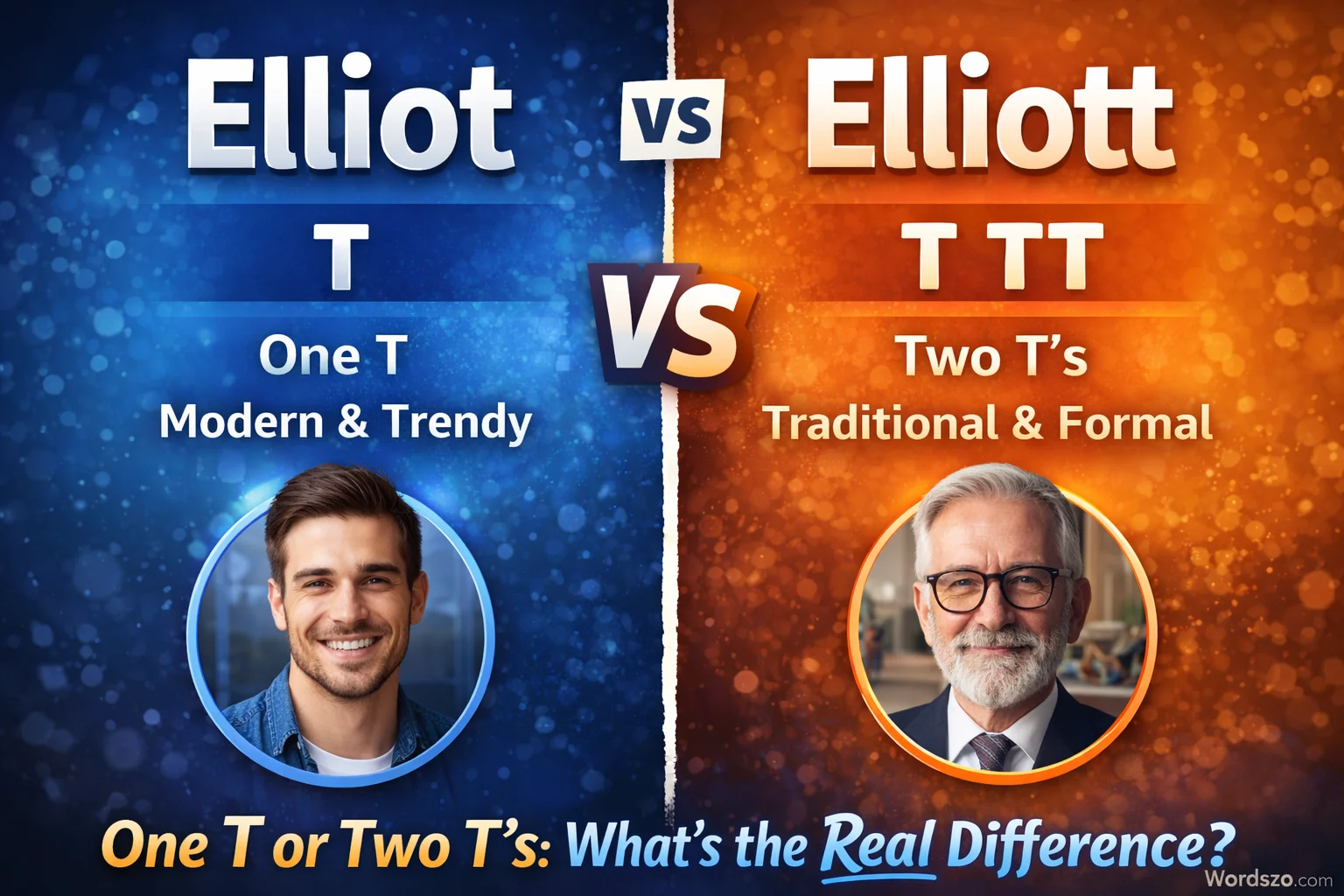
- Elliot uses one T
- Elliott uses two T’s
- Both are correct spellings
- Neither spelling is grammatically superior
- Choice depends on tradition, preference, or branding
Comparison Table: Elliot vs Elliott
| Feature | Elliot | Elliott |
|---|---|---|
| Number of T’s | One | Two |
| Traditional Usage | Modern variant | Traditional form |
| Common as First Name | Yes | Yes |
| Common as Surname | Less common | Very common |
| Pronunciation | Same | Same |
| Regional Restriction | None | None |
| Popular in Branding | Yes | Moderate |
| Historical Roots | Simplified | Strong historical roots |
Real-Life Conversation Examples
Dialogue 1
A: “Is it Elliot or Elliott?”
B: “Both are correct—it depends on the person’s name.”
🎯 Lesson: Always follow the individual’s preferred spelling.
Dialogue 2
A: “Why does his name have two T’s?”
B: “That’s the traditional Elliott spelling.”
🎯 Lesson: Double-T often reflects tradition.
Dialogue 3
A: “I like Elliot better.”
B: “Yeah, it looks more modern and clean.”
🎯 Lesson: Single-T spelling feels more contemporary.
Dialogue 4
A: “Is Elliot American and Elliott British?”
B: “Not really—both are used everywhere.”
🎯 Lesson: Geography doesn’t strictly define spelling.
Dialogue 5
A: “Why did the editor change Elliot to Elliott?”
B: “They probably followed the author’s official name.”
🎯 Lesson: Accuracy matters more than preference.
When to Use Elliot vs Elliott
Use “Elliot” When:
- The person spells their name with one T
- You prefer a modern or minimalist style
- Creating a brand or character name
- Writing informal or contemporary content
Examples:
- “The startup was founded by Elliot Reed.”
- “Elliot is my favorite character in the story.”
Use “Elliott” When:
- The person’s name officially uses two T’s
- Referring to a surname
- Writing historical or formal content
- Following family or legal records
Examples:
- “Elliott Johnson signed the contract.”
- “The Elliott family has lived here for generations.”
Simple Memory Trick
- One T = Trendy
- Two T’s = Traditional
Both are correct—just be consistent.
Fun Facts or History
1. Surname Origins
The surname Elliott originated in Scotland and northern England, which explains why the double-T spelling appears more frequently in historical records.
2. Pop Culture Usage
Modern movies, books, and TV shows increasingly use Elliot for fictional characters because it looks cleaner and fits modern naming trends.
Conclusion
The difference between Elliot vs Elliott comes down to spelling, tradition, and personal preference, not correctness. Both versions are legitimate, widely accepted, and pronounced the same way. Elliott leans traditional and is more common as a surname, while Elliot feels modern and streamlined. The key rule is simple: always use the spelling that matches the individual’s name or the context you’re writing in. Once you understand this, the confusion disappears completely. Next time someone uses these two names, you’ll know exactly what they mean!