Introduction
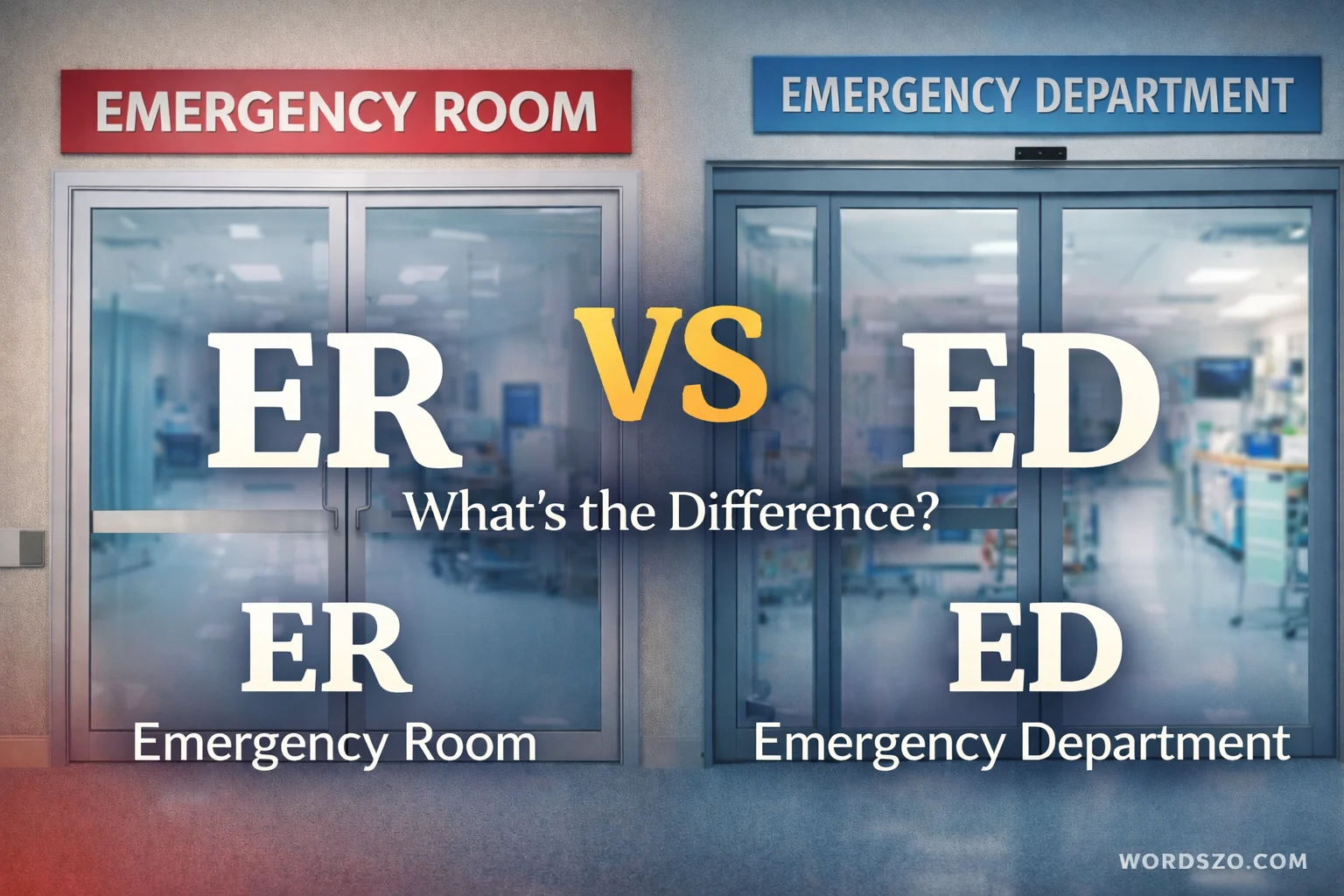
If you’ve ever watched a medical drama or rushed someone to the hospital, you’ve probably heard the terms ER and ED used interchangeably. Many people assume they mean the exact same thing—and honestly, that’s not a strange assumption. They’re often used in the same situations, by the same people, and for the same emergencies. This overlap is why the confusion around ER vs ED is so common. However, in modern healthcare, these two terms don’t carry exactly the same meaning anymore. Although they look/sound similar, they serve completely different purposes. One is a traditional term rooted in history, while the other reflects how emergency care is structured today. In this guide, we’ll clearly explain what ER and ED mean, how they differ, and when each term is correctly used.
Section 1: What Is “ER”?
ER stands for Emergency Room. It’s the older and more familiar term most people grew up hearing.
Clear Meaning
An Emergency Room refers to a specific room or area in a hospital where patients receive urgent medical care. In the ER vs ED discussion, ER focuses on a physical space rather than a full medical system.
How It’s Used
ER is commonly used in:
- Casual conversation
- Movies and TV shows
- Older hospital signage
- Informal writing
People usually say “Go to the ER” when someone needs immediate attention.
Where It’s Used
ER is primarily used in:
- United States (informal speech)
- Older medical literature
- Pop culture
While still widely understood, it’s less common in official medical documentation today.
Examples in Sentences
- “They rushed him to the ER after the accident.”
- “I spent the night waiting in the ER.”
- “The ER was crowded during the weekend.”
Short Historical Note
The term Emergency Room became popular in the mid-20th century, when emergency care was literally handled in one dedicated room of the hospital. This historical context explains why ER is still deeply embedded in everyday language, even in the modern ER vs ED debate.
Section 2: What Is “ED”?
ED stands for Emergency Department, the term now preferred in modern healthcare systems.
Clear Meaning
An Emergency Department is a fully organized hospital department that provides emergency medical care. In the ER vs ED comparison, ED reflects a broader, more accurate scope of services.
How It’s Used
ED is used in:
- Medical records
- Hospital administration
- Academic and clinical writing
- Official healthcare communication
It acknowledges that emergency care involves multiple rooms, teams, and specialties—not just one room.
Where It’s Used
ED is the standard term in:
- United States hospitals (formal use)
- Canada
- UK, Australia, and other countries
- Medical education and research
Globally, ED has become the professional standard.
Examples in Sentences
- “The patient was admitted through the ED.”
- “She works as a nurse in the ED.”
- “The ED operates 24 hours a day.”
Usage Note
Unlike ER, ED aligns with how emergency medicine functions today—covering triage, imaging, trauma bays, and observation units. This modern scope is the key distinction in ER vs ED.
Key Differences Between ER and ED
Although they’re often used interchangeably, ER vs ED has clear technical differences.
Bullet Point Differences
- ER refers to a room; ED refers to a department
- ER is informal; ED is professional
- ED reflects modern emergency medicine
- ER is common in conversation; ED in documentation
- Hospitals officially use ED
Comparison Table (Mandatory)
| Feature | ER (Emergency Room) | ED (Emergency Department) |
|---|---|---|
| Full Form | Emergency Room | Emergency Department |
| Scope | Single room concept | Entire hospital department |
| Usage Style | Informal | Formal/Clinical |
| Medical Accuracy | Outdated | Current standard |
| Used in Records | Rarely | Always |
| Public Understanding | Very common | Increasingly common |
This table makes the ER vs ED distinction easy to understand at a glance.
Real-Life Conversation Examples
Dialogue 1
A: “Take him to the ER now!”
B: “Yes, the emergency department is ready.”
🎯 Lesson: ER and ED point to the same care, but ED is the formal term.
Dialogue 2
A: “Why does the hospital say ED instead of ER?”
B: “Because it’s an entire department, not just one room.”
🎯 Lesson: ED reflects modern hospital structure.
Dialogue 3
A: “I work in the ER.”
B: “So you’re part of the ED team?”
🎯 Lesson: Healthcare workers usually say ED professionally.
Dialogue 4
A: “The report says ED, but I thought it was ER.”
B: “They mean the same place, just different terminology.”
🎯 Lesson: Meaning overlaps, terminology differs.
When to Use ER vs ED
Choosing between ER vs ED depends on context.
Use “ER” When:
- Speaking casually
- Writing non-technical content
- Talking to the general public
- Referring to TV or movies
Memory Trick: ER = Everyday разговор (casual speech)
Use “ED” When:
- Writing medical or professional content
- Referring to hospital departments
- Creating academic or SEO healthcare articles
- Using official documentation
Memory Trick: ED = Entire Department
Writing Tip
For SEO and medical accuracy, using ED is recommended, with ER mentioned early for familiarity. This balanced approach works best when covering ER vs ED.
Fun Facts or History
- Emergency Medicine became a recognized medical specialty in the 1970s, which accelerated the shift from ER to ED.
- Many hospitals removed “ER” signs entirely, replacing them with ED to reflect expanded services.
These changes explain why ER vs ED is more than just a spelling difference.
Conclusion
The difference between ER vs ED is subtle but important. ER, or Emergency Room, is an older, informal term that focuses on a physical space. ED, or Emergency Department, is the modern and medically accurate term that reflects how emergency care actually works today. While both refer to the same place for urgent treatment, ED is now the professional standard. Knowing this difference helps you understand medical language, hospital signs, and healthcare content more clearly. Next time someone uses these two words, you’ll know exactly what they mean! 🚑