Introduction
If you’ve ever shopped for a rifle scope, you’ve probably come across the debate: FFP vs SFP. At first glance, they seem like technical abbreviations that only expert shooters understand. But in reality, the difference is easier to grasp than you might think.
Many shooters confuse these two because both refer to reticle placement inside a scope. They look almost identical from the outside, and both help you aim more precisely. However, the way the reticle behaves when you zoom in or out makes a big difference.
Although they look/sound similar, they serve completely different purposes.
Whether you’re into hunting, tactical shooting, or long-range precision, understanding FFP vs SFP can dramatically improve your accuracy and confidence. Let’s break it down clearly and simply.
What Is FFP?
FFP stands for First Focal Plane.
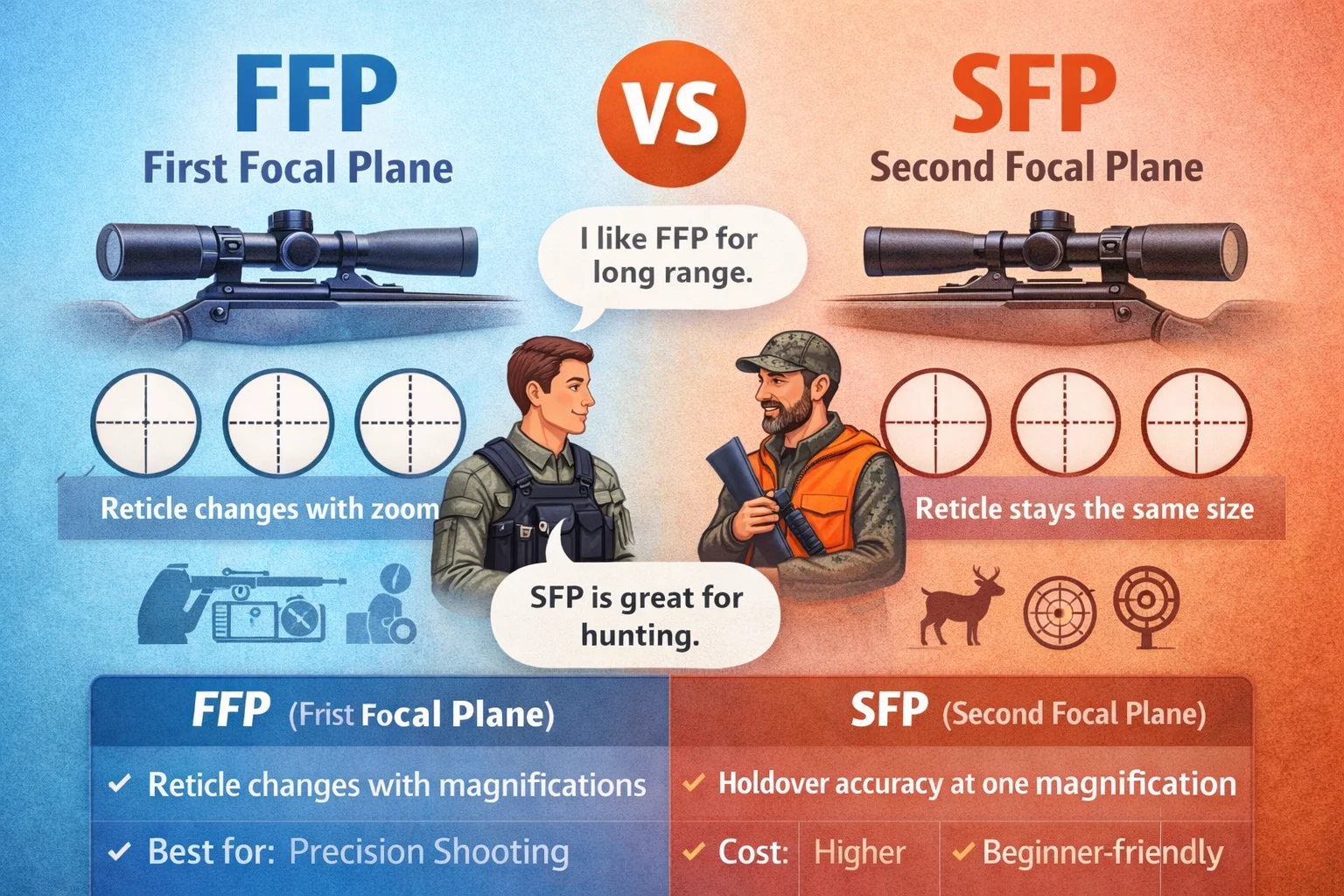
In an FFP scope, the reticle (the crosshair or aiming pattern) is placed in front of the magnification lenses. This means the reticle changes size as you adjust magnification.
When you zoom in:
- The reticle appears larger.
When you zoom out:
- The reticle appears smaller.
How It’s Used
FFP scopes are popular among:
- Long-range shooters
- Tactical and military users
- Precision competition shooters
The biggest advantage in the FFP vs SFP comparison is that the reticle’s hash marks remain accurate at all magnification levels.
That means your holdover and windage markings work whether you’re at 5x, 10x, or 20x zoom.
Example Sentences
- “I prefer an FFP scope for long-range competitions.”
- “With FFP, my reticle adjustments stay accurate at any zoom.”
- “Most tactical shooters choose FFP.”
Short Historical Note
FFP scopes became widely popular in military and precision shooting communities because they allow quick adjustments without needing to set the scope at a specific magnification.
In the FFP vs SFP debate, FFP is often seen as more versatile for advanced shooting scenarios.
What Is SFP?
SFP stands for Second Focal Plane.
In an SFP scope, the reticle is positioned behind the magnification lenses. This means the reticle stays the same size no matter how much you zoom in or out.
The target image grows or shrinks—but the reticle does not.
How It’s Used
SFP scopes are extremely common among:
- Hunters
- Beginner shooters
- Casual range users
In the FFP vs SFP discussion, SFP scopes are usually more affordable and simpler to use.
However, there’s a key limitation:
The reticle’s holdover markings are only accurate at one specific magnification level (usually the highest).
Example Sentences
- “I use an SFP scope for deer hunting.”
- “With SFP, the reticle size never changes.”
- “You have to be at max magnification for accurate holdovers.”
Usage Notes
SFP scopes dominate the hunting market because:
- They’re typically less expensive
- The reticle remains easy to see at low magnification
- Most hunters shoot at fixed or moderate ranges
When comparing FFP vs SFP, SFP is often preferred for simplicity and cost-effectiveness.
Key Differences Between FFP and SFP
Let’s simplify the FFP vs SFP comparison.
Main Differences
- FFP reticle changes size with zoom.
- SFP reticle stays the same size.
- FFP holdovers are accurate at all magnifications.
- SFP holdovers are accurate at one magnification.
- FFP scopes are usually more expensive.
- SFP scopes are often easier for beginners.
Comparison Table: FFP vs SFP
| Feature | FFP (First Focal Plane) | SFP (Second Focal Plane) |
|---|---|---|
| Reticle Size | Changes with magnification | Stays the same |
| Holdover Accuracy | Accurate at all magnifications | Accurate at one magnification |
| Best For | Long-range, tactical shooting | Hunting, general shooting |
| Cost | Usually higher | Usually lower |
| Complexity | More advanced | Beginner-friendly |
| Reticle Visibility | Can become thin at low zoom | Always consistent |
This table makes the FFP vs SFP difference easy to understand at a glance.
Real-Life Conversation Examples
Dialogue 1
Jake: Why does your reticle get bigger when you zoom?
Liam: It’s an FFP scope.
Jake: Oh, that explains it!
🎯 Lesson: FFP reticles change size with magnification.
Dialogue 2
Tom: My holdovers aren’t lining up.
Chris: Are you using SFP at max zoom?
Tom: Nope. That’s probably why.
🎯 Lesson: SFP holdovers only work correctly at a specific magnification.
Dialogue 3
Alex: Should I buy FFP or SFP?
Ryan: Are you shooting long range?
Alex: Yes.
Ryan: Then FFP might be better.
🎯 Lesson: FFP is ideal for precision and long-range shooting.
Dialogue 4
Sam: I just hunt deer at 200 yards.
Ben: SFP will work perfectly for that.
Sam: And it’s cheaper too!
🎯 Lesson: SFP is often enough for typical hunting distances.
When to Use FFP vs SFP
Choosing between FFP vs SFP depends on your shooting style.
Choose FFP If:
- You shoot at varying distances
- You frequently adjust magnification
- You use holdovers regularly
- You compete in precision shooting
- You want maximum flexibility
Choose SFP If:
- You mostly hunt at known distances
- You prefer a constant reticle size
- You’re a beginner
- You want a more budget-friendly option
- You rarely change magnification for calculations
Simple Memory Trick
Think of it this way:
- First Focal Plane = Flexible
- Second Focal Plane = Steady
FFP moves with zoom.
SFP stays steady.
That’s the easiest way to remember the FFP vs SFP difference.
Fun Facts
1️⃣ Many professional snipers prefer FFP because they can range targets at any magnification.
2️⃣ SFP scopes dominated the market for decades before FFP became popular in civilian shooting sports.
Technology continues to evolve, but the core difference between FFP vs SFP remains the same: reticle behavior.
Conclusion
Understanding the difference between FFP vs SFP can help you choose the right scope for your needs. FFP scopes adjust the reticle size with magnification, keeping holdovers accurate at all zoom levels. SFP scopes keep the reticle size fixed, but their holdover markings only work correctly at one magnification setting.
Neither option is universally better—it depends on how and where you shoot. Long-range precision shooters often prefer FFP, while hunters and beginners usually lean toward SFP.
Now that you know the difference, you can shop smarter and shoot more confidently.
Next time someone mentions FFP or SFP, you’ll know exactly what they mean!