Introduction
If you’ve ever been told you have a growth in your uterus, you may have immediately searched online for answers. Very quickly, you probably came across two common terms: fibroids vs polyps. At first glance, they sound similar. Both are abnormal growths. Both can cause heavy bleeding. And both are usually non-cancerous.
So it’s easy to assume they’re basically the same thing.
But here’s the truth: Although they look/sound similar, they serve completely different purposes.
Understanding the difference between fibroids vs polyps can help you feel more confident during doctor visits and better understand your treatment options. While both affect the uterus, they grow in different ways, come from different tissues, and are treated differently.
Let’s break it down clearly and simply.
What Is a Fibroid?
A fibroid (also called a uterine fibroid or leiomyoma) is a non-cancerous tumor made of muscle and fibrous tissue that grows in or on the uterus.
Fibroids develop from the muscular wall of the uterus. They can grow:
- Inside the uterine wall (intramural)
- On the outer surface of the uterus (subserosal)
- Inside the uterine cavity (submucosal)
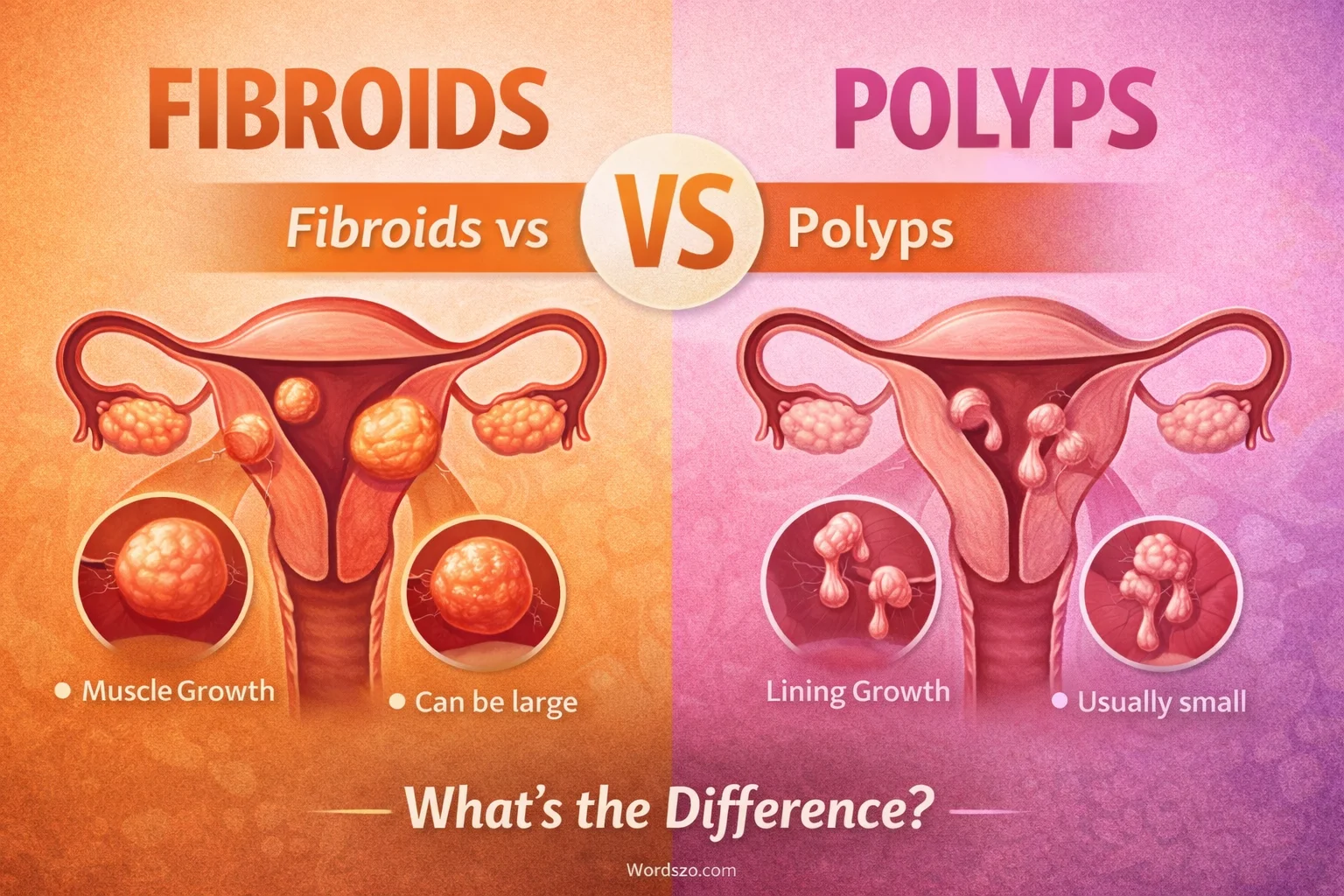
When comparing fibroids vs polyps, the key difference starts with tissue type. Fibroids are made of muscle tissue, while polyps are not.
How It’s Used (Medical Context)
Doctors often say:
- “You have uterine fibroids.”
- “Your fibroids are causing heavy periods.”
- “The fibroid is pressing on your bladder.”
Fibroids are extremely common. Studies suggest that up to 70–80% of women may develop fibroids by age 50, although not all cause symptoms.
Common Symptoms of Fibroids
- Heavy or prolonged periods
- Pelvic pressure or pain
- Frequent urination
- Lower back pain
- Fertility challenges (in some cases)
Some fibroids are tiny and cause no symptoms. Others can grow as large as a grapefruit.
Example Sentences
- “My doctor found a fibroid during my ultrasound.”
- “She needed surgery to remove a large fibroid.”
- “Fibroids can shrink after menopause.”
Short Historical Note
Fibroids have been documented in medical literature for centuries. Before modern imaging, they were often discovered only during surgery. Today, ultrasounds and MRIs make diagnosis much easier.
In the fibroids vs polyps comparison, fibroids tend to be larger and deeper in the uterine wall.
What Is a Polyp?
A polyp (specifically a uterine polyp or endometrial polyp) is a small growth that forms in the lining of the uterus.
Unlike fibroids, polyps grow from the endometrium, which is the inner lining of the uterus. They are usually soft and attached by a thin stalk or broad base.
When discussing fibroids vs polyps, remember this:
- Fibroids grow from muscle.
- Polyps grow from the uterine lining.
How It’s Used (Medical Context)
Doctors may say:
- “You have an endometrial polyp.”
- “The polyp is causing spotting between periods.”
- “We’ll remove the polyp during a simple procedure.”
Polyps are generally smaller than fibroids, often ranging from a few millimeters to a few centimeters.
Common Symptoms of Polyps
- Irregular bleeding
- Spotting between periods
- Bleeding after menopause
- Fertility issues (sometimes)
Many polyps cause no symptoms and are discovered during routine exams.
Regional & Terminology Notes
In medical English worldwide (US, UK, Australia), the term endometrial polyp is standard. There are no major spelling differences like there are with some medical terms.
When comparing fibroids vs polyps, polyps are usually smaller, softer, and located inside the uterine cavity.
Example Sentences
- “The ultrasound showed a small uterine polyp.”
- “My polyp was removed with a hysteroscopy.”
- “Polyps are usually benign.”
Key Differences Between Fibroids and Polyps
Let’s simplify the fibroids vs polyps comparison.
Main Differences
- Fibroids are made of muscle tissue.
- Polyps are made of uterine lining tissue.
- Fibroids can grow large.
- Polyps are usually small.
- Fibroids often cause pressure symptoms.
- Polyps commonly cause irregular spotting.
- Fibroids grow in the uterine wall.
- Polyps grow in the uterine lining.
Comparison Table: Fibroids vs Polyps
| Feature | Fibroids | Polyps |
|---|---|---|
| Tissue Type | Muscle & fibrous tissue | Uterine lining (endometrium) |
| Location | In or on uterine wall | Inside uterine cavity |
| Size | Can be large (even grapefruit-sized) | Usually small |
| Texture | Firm | Soft |
| Common Symptom | Heavy bleeding & pressure | Irregular spotting |
| Cancer Risk | Rarely cancerous | Rarely cancerous (slightly higher risk after menopause) |
| Treatment | Medication, surgery, embolization | Usually simple removal |
This table makes the difference between fibroids vs polyps clear at a glance.
Real-Life Conversation Examples
Dialogue 1
Anna: My doctor said I have a fibroid.
Maya: Is that like a polyp?
Anna: No, it’s growing in the muscle wall.
🎯 Lesson: Fibroids grow from muscle tissue, not lining tissue.
Dialogue 2
Lisa: I’ve been spotting between periods.
Doctor: It might be a uterine polyp.
Lisa: Is that serious?
Doctor: Usually not, and it’s easy to remove.
🎯 Lesson: Polyps often cause irregular bleeding and are typically simple to treat.
Dialogue 3
Nina: My fibroid is pressing on my bladder.
Sara: Wow, mine was just a small polyp.
Nina: That’s the difference!
🎯 Lesson: Fibroids can grow large and cause pressure symptoms.
Dialogue 4
Emma: What’s the difference between fibroids vs polyps?
Doctor: Fibroids are muscle growths. Polyps are lining growths.
Emma: That’s much clearer now.
🎯 Lesson: The key difference is tissue type and location.
When to Worry About Fibroids vs Polyps
Both fibroids and polyps are usually benign (non-cancerous). However, you should consult a doctor if you experience:
- Very heavy bleeding
- Bleeding after menopause
- Severe pelvic pain
- Fertility struggles
- Rapid growth of a mass
When Treatment Is Needed
Fibroids may require treatment if they:
- Cause severe symptoms
- Affect fertility
- Grow rapidly
Polyps are often removed if they:
- Cause abnormal bleeding
- Appear after menopause
- Interfere with pregnancy
Simple Memory Trick
Think of it this way:
- F = Firm & Fibrous (Fibroids)
- P = Petite & Pink lining (Polyps)
Fibroids = muscle wall.
Polyps = inner lining.
That’s the easiest way to remember the fibroids vs polyps difference.
Fun Facts
1️⃣ Fibroids are one of the most common reasons for hysterectomy worldwide.
2️⃣ Some small polyps can disappear on their own without treatment.
Medical technology now allows many fibroids and polyps to be removed with minimally invasive procedures.
Conclusion
Understanding the difference between fibroids vs polyps can reduce anxiety and help you make informed health decisions. Fibroids are firm, muscle-based growths that can become large and cause pressure or heavy bleeding. Polyps are softer growths from the uterine lining that often cause irregular spotting.
While both are usually non-cancerous, they differ in size, location, and treatment approaches. Knowing which one you’re dealing with helps you ask the right questions and choose the best care plan.
Next time someone mentions fibroids or polyps, you’ll know exactly what they mean!