Introduction
Have you ever watched a horror movie and wondered whether the figure floating down the hallway was a ghost or spirit? Most people use these two words interchangeably. They both describe supernatural beings. They both refer to something beyond the physical world. And in everyday conversations, they often mean the same thing.
But here’s where things get interesting.
Although they look/sound similar, they serve completely different purposes.
The difference between ghost vs spirit depends on culture, religion, and even context. One word is often linked to hauntings and unfinished business, while the other can carry a more peaceful or philosophical meaning. If you’ve ever been confused about which term to use, this guide will clear things up in a simple, conversational way.
Let’s explore the difference.
What Is a Ghost?
A ghost is traditionally believed to be the soul or spirit of a dead person that appears to the living, often connected to a specific place or event.
In the ghost vs spirit discussion, a ghost is usually portrayed as something that:
- Haunts houses
- Appears in dark hallways
- Makes unexplained noises
- Has unfinished business
How It’s Used
In modern English, the word ghost is strongly associated with:
- Horror stories
- Haunted locations
- Supernatural folklore
- Halloween themes
Examples in conversation:
- “That old mansion is full of ghosts.”
- “I think I saw a ghost last night.”
- “The hotel is rumored to be haunted by a ghost.”
Cultural Context
In Western folklore, ghosts are often seen as trapped souls who cannot move on. In some Asian cultures, ghosts may return during certain festivals to visit the living.
The word comes from the Old English gāst, which originally meant “spirit” or “breath.” Over time, the meaning narrowed to describe the apparition of a dead person.
In the ghost vs spirit comparison, ghosts are often considered more dramatic, visible, and connected to specific locations.
What Is a Spirit?
A spirit is a broader and more flexible term. It generally refers to the non-physical essence of a being, not necessarily tied to haunting or fear.
When discussing ghost vs spirit, the word spirit can mean:
- The soul of a person
- A divine or religious presence
- An energy or life force
- A supernatural being (not always human)
How It’s Used
The term spirit appears in:
- Religious texts
- Philosophical discussions
- Motivational speech
- Cultural traditions
Examples:
- “May her spirit rest in peace.”
- “He has a strong competitive spirit.”
- “The Holy Spirit is central to Christian belief.”
Notice how “spirit” is not always spooky. It often carries a positive or neutral meaning.
Regional & Religious Notes
In Christianity, Islam, Hinduism, and many other religions, “spirit” refers to the soul or divine presence. It is rarely used in a frightening sense.
In contrast, in horror movies, the word “ghost” is more common.
So in the ghost vs spirit debate, spirit is broader, more abstract, and often less scary.
Key Differences Between Ghost and Spirit
Let’s simplify the ghost vs spirit comparison.
Main Differences
- Ghosts are usually dead humans appearing visibly.
- Spirits are non-physical essences, not always visible.
- Ghosts are linked to hauntings.
- Spirits are linked to religion, energy, or the soul.
- Ghost often has a spooky tone.
- Spirit can have a peaceful or philosophical tone.
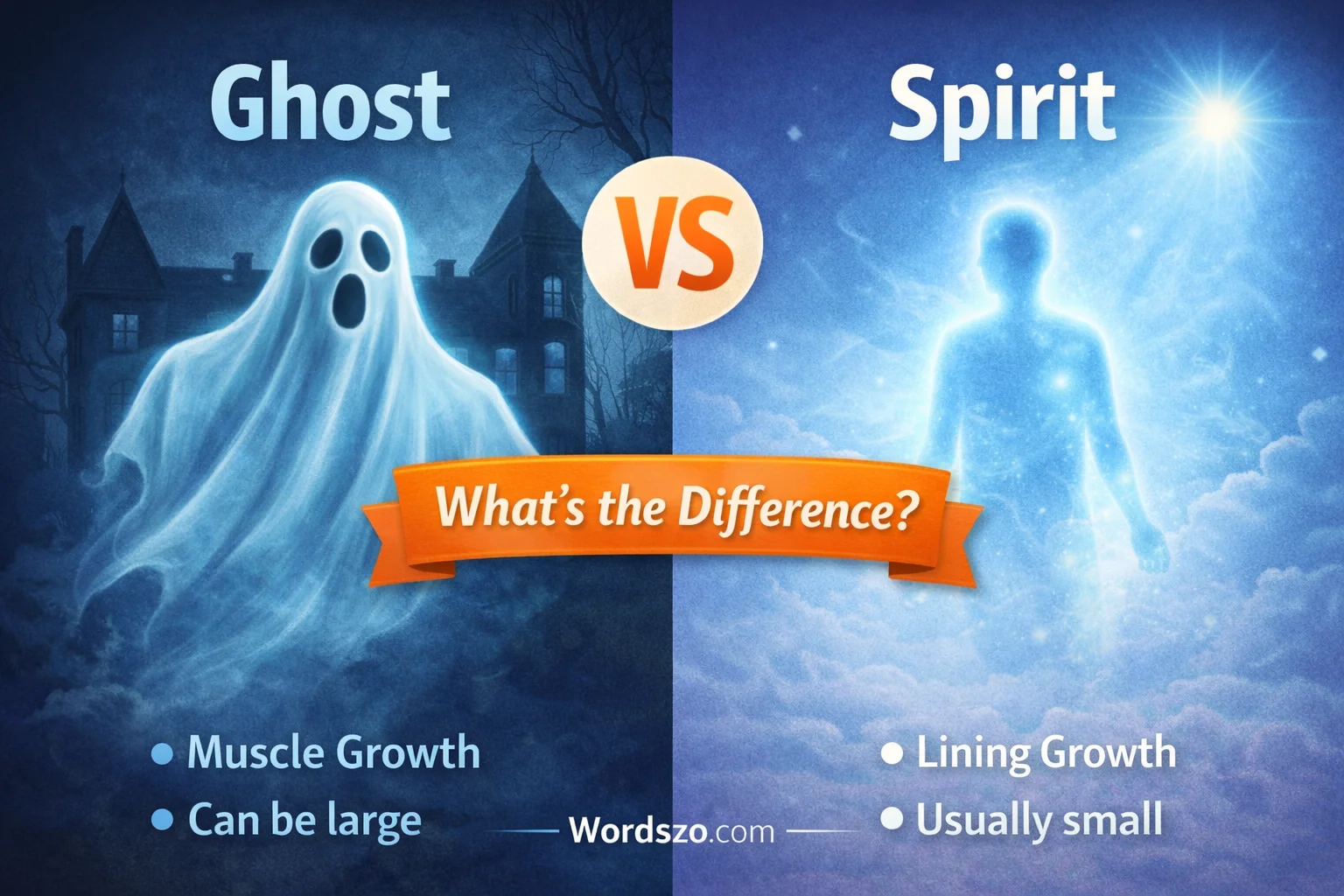
Comparison Table: Ghost vs Spirit
| Feature | Ghost | Spirit |
|---|---|---|
| Definition | Apparition of a dead person | Non-physical essence or soul |
| Tone | Often scary | Neutral or positive |
| Religious Use | Rarely formal | Common in religion |
| Visibility | Often visible in stories | Not always visible |
| Cultural Link | Haunted places | Soul, energy, divine presence |
| Emotional Feel | Fear, mystery | Peace, energy, faith |
This table makes the ghost vs spirit difference clear at a glance.
Real-Life Conversation Examples
Dialogue 1
Emma: I think my house is haunted.
Lily: By a ghost?
Emma: Yes, I heard footsteps upstairs.
🎯 Lesson: Ghosts are usually connected to haunted places.
Dialogue 2
Mark: May his spirit rest in peace.
John: That’s a beautiful way to say it.
🎯 Lesson: Spirit is often used in a peaceful or respectful way.
Dialogue 3
Anna: Is a ghost the same as a spirit?
Tom: Not exactly. A ghost is usually a dead person haunting somewhere.
Anna: Oh, so spirit is broader?
🎯 Lesson: Spirit is a wider term than ghost.
Dialogue 4
Chris: I felt a spiritual presence in the temple.
Sam: You mean a ghost?
Chris: No, more like a divine spirit.
🎯 Lesson: Spirit can refer to divine or religious energy.
When to Use Ghost vs Spirit
Choosing between ghost vs spirit depends on tone and context.
Use “Ghost” When:
- Talking about haunted houses
- Referring to horror stories
- Describing apparitions
- Discussing folklore
Use “Spirit” When:
- Talking about religion
- Referring to the soul
- Describing energy or attitude
- Expressing something symbolic
Simple Memory Trick
Think of it this way:
- Ghost = Graveyard
- Spirit = Soul
Ghost feels spooky.
Spirit feels spiritual.
That’s the easiest way to remember the ghost vs spirit difference.
Fun Facts
1️⃣ The word “ghost” and “spirit” originally meant the same thing centuries ago. Language evolved to separate their meanings.
2️⃣ In many cultures, not all spirits are ghosts—but some ghosts are considered spirits.
Language reflects culture, and that’s especially true in the ghost vs spirit debate.
Conclusion
The difference between ghost vs spirit comes down to tone, meaning, and context. A ghost usually refers to the visible apparition of a dead person, often connected to hauntings or unfinished business. A spirit, on the other hand, is a broader term that refers to the soul, energy, or divine presence.
While people often use the words interchangeably, they carry different emotional and cultural meanings. Understanding this distinction helps you communicate more clearly and accurately.
Next time someone uses these two words, you’ll know exactly what they mean!