Introduction
Language changes as society changes—and few terms show this more clearly than homeless vs unhoused. You’ve probably seen both words used in news articles, social media, or policy discussions, often referring to the same group of people. That overlap is exactly why many readers assume the terms are interchangeable.
But in reality, homeless vs unhoused reflects more than vocabulary—it reflects perspective, intent, and sensitivity. One term has been used for decades, while the other emerged as part of a broader movement toward people-first language. Writers, journalists, and organizations now debate which word is more accurate, respectful, or appropriate depending on context.
Although they look/sound similar, they serve completely different purposes.
In this guide, we’ll clearly explain what each term means, how and where it’s used, and when one is more appropriate than the other—so you can write with confidence, clarity, and compassion.
Section 1: What Is Homeless?
Homeless is the traditional and most widely recognized term used to describe people who do not have a fixed, permanent place to live.
Clear Meaning
Homeless refers to individuals or families lacking stable housing. This may include people living on the streets, in shelters, in cars, or in temporary accommodations.
How It’s Used
In the homeless vs unhoused discussion, homeless is commonly used in:
- Government policies
- Legal documents
- Media reporting
- Statistical and research contexts
It functions as both an adjective (homeless individuals) and a noun (the homeless), though the noun form has become increasingly controversial.
Where It’s Used
The term homeless is used globally, especially in:
- The United States
- The United Kingdom
- International NGOs and policy frameworks
There are no spelling or grammar variations across regions.
Examples in Sentences
- The city opened a new shelter for homeless residents.
- Homeless populations increased during the economic downturn.
- In the homeless vs unhoused debate, homeless remains the legal term.
Short Historical or Usage Note
The word homeless has been in common use since the late 19th century. Over time, critics argued that it defines people by what they lack, rather than recognizing their humanity beyond housing status.
Section 2: What Is Unhoused?
Unhoused is a newer, more intentional term used to describe people without housing—while avoiding identity-defining language.
Clear Meaning
Unhoused refers to people who currently do not have stable housing but emphasizes that housing is a condition, not an identity.
How It’s Used
In the homeless vs unhoused conversation, unhoused is often used to:
- Center people first
- Reduce stigma
- Shift focus toward systemic housing issues
It is usually paired with people-first language, such as unhoused individuals or unhoused people.
Where It’s Used
Unhoused is most common in:
- Academic writing
- Advocacy groups
- Progressive journalism
- West Coast US cities (e.g., California, Oregon)
It is less common in legal and governmental documents.
Examples in Sentences
- The nonprofit supports unhoused people with mental health services.
- Unhoused communities face barriers beyond shelter access.
- Many writers now prefer unhoused in the homeless vs unhoused debate.
Regional or Grammatical Notes
“Unhoused” is primarily American English and is rarely used in UK policy language. Grammatically, it functions only as an adjective—not a noun.
Key Differences Between Homeless and Unhoused
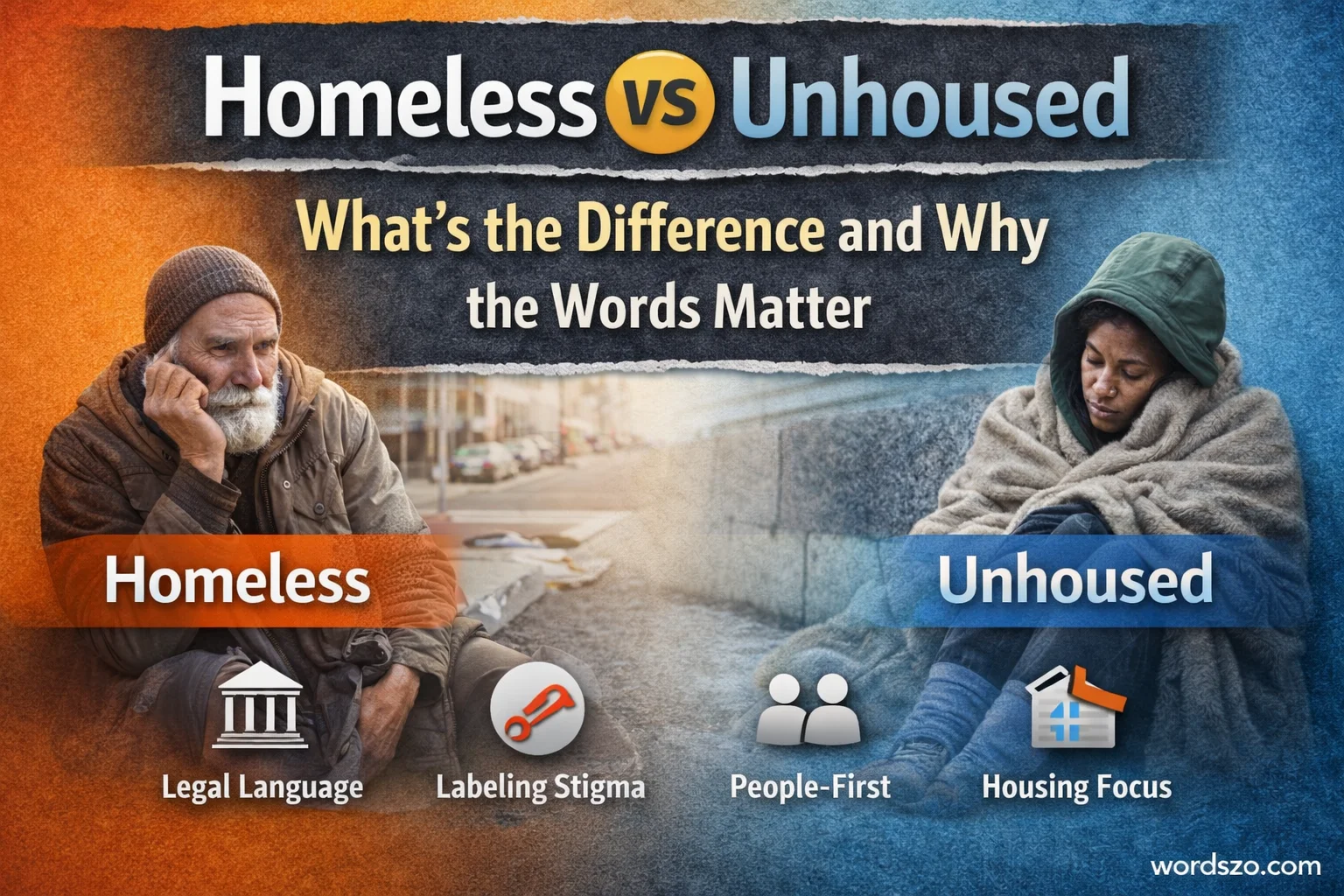
Understanding homeless vs unhoused requires looking at tone, intent, and context—not just definition.
Bullet Point Differences
- Homeless is traditional and widely recognized
- Unhoused is modern and people-first
- Homeless is common in laws and statistics
- Unhoused is common in advocacy and journalism
- Homeless can feel identity-defining
- Unhoused emphasizes a temporary condition
Homeless vs Unhoused Comparison Table
| Feature | Homeless | Unhoused |
|---|---|---|
| Age of Term | Long-established | Relatively new |
| Tone | Neutral to institutional | People-centered |
| Use in Law & Policy | Very common | Rare |
| Use in Advocacy | Declining | Increasing |
| Identity Implication | Often criticized | Minimizes labeling |
| Global Recognition | High | Limited |
Real-Life Conversation Examples
Dialogue 1
A: Should I say homeless or unhoused in my article?
B: Depends on whether you’re writing policy or advocacy.
🎯 Lesson: Context matters in homeless vs unhoused usage.
Dialogue 2
A: Why do some people dislike the word homeless?
B: They feel it defines people by their hardship.
🎯 Lesson: Language shapes perception.
Dialogue 3
A: Is unhoused just a trend?
B: No—it reflects a shift toward people-first language.
🎯 Lesson: Unhoused signals intent, not fashion.
Dialogue 4
A: Can I use both terms in one article?
B: Yes—if you explain your choice clearly.
🎯 Lesson: Transparency builds trust.
When to Use Homeless vs Unhoused
Practical Usage Rules
Use homeless when:
- Writing legal or government documents
- Reporting official statistics
- Quoting laws or policies
Use unhoused when:
- Writing advocacy or human-interest pieces
- Focusing on dignity and lived experience
- Addressing systemic housing issues
Simple Memory Tricks
- Homeless = Institutional language
- Unhoused = Human-centered language
US vs UK Usage
In the US, homeless vs unhoused is actively debated. In the UK, homeless remains the dominant and widely accepted term, with unhoused rarely used.
Fun Facts or History
- Many style guides now recommend “people experiencing homelessness” as an alternative to both terms.
- Several US cities have officially shifted internal communications from homeless to unhoused.
Conclusion
The difference between homeless vs unhoused goes far beyond semantics. While both terms describe the absence of stable housing, they carry different tones, histories, and intentions. Homeless remains widely used and understood, especially in policy and law. Unhoused reflects a modern effort to reduce stigma and emphasize humanity over labels.
Neither term is inherently right or wrong—the key is intent, audience, and clarity. When used thoughtfully, language can inform without harming and describe without defining.
Next time someone uses these two words, you’ll know exactly what they mean!