Introduction
Have you ever paused while writing and wondered whether joyful or joyous sounds more natural? You’re not alone. These two words appear almost interchangeable, sound closely related, and both revolve around the idea of happiness. That’s exactly why so many people confuse them—students, writers, bloggers, and even native English speakers.
At first glance, joyful vs joyous feels like a simple spelling variation, but the truth goes much deeper. Each word carries a slightly different emotional weight, tone, and usage pattern. Although they look and sound similar, they serve completely different purposes.
Understanding this difference can instantly improve your writing clarity, emotional impact, and professionalism. Whether you’re crafting a heartfelt message, a formal article, or casual conversation, choosing the right word matters. Let’s break it down in a friendly, clear, and practical way 😊
What Is “Joyful”?
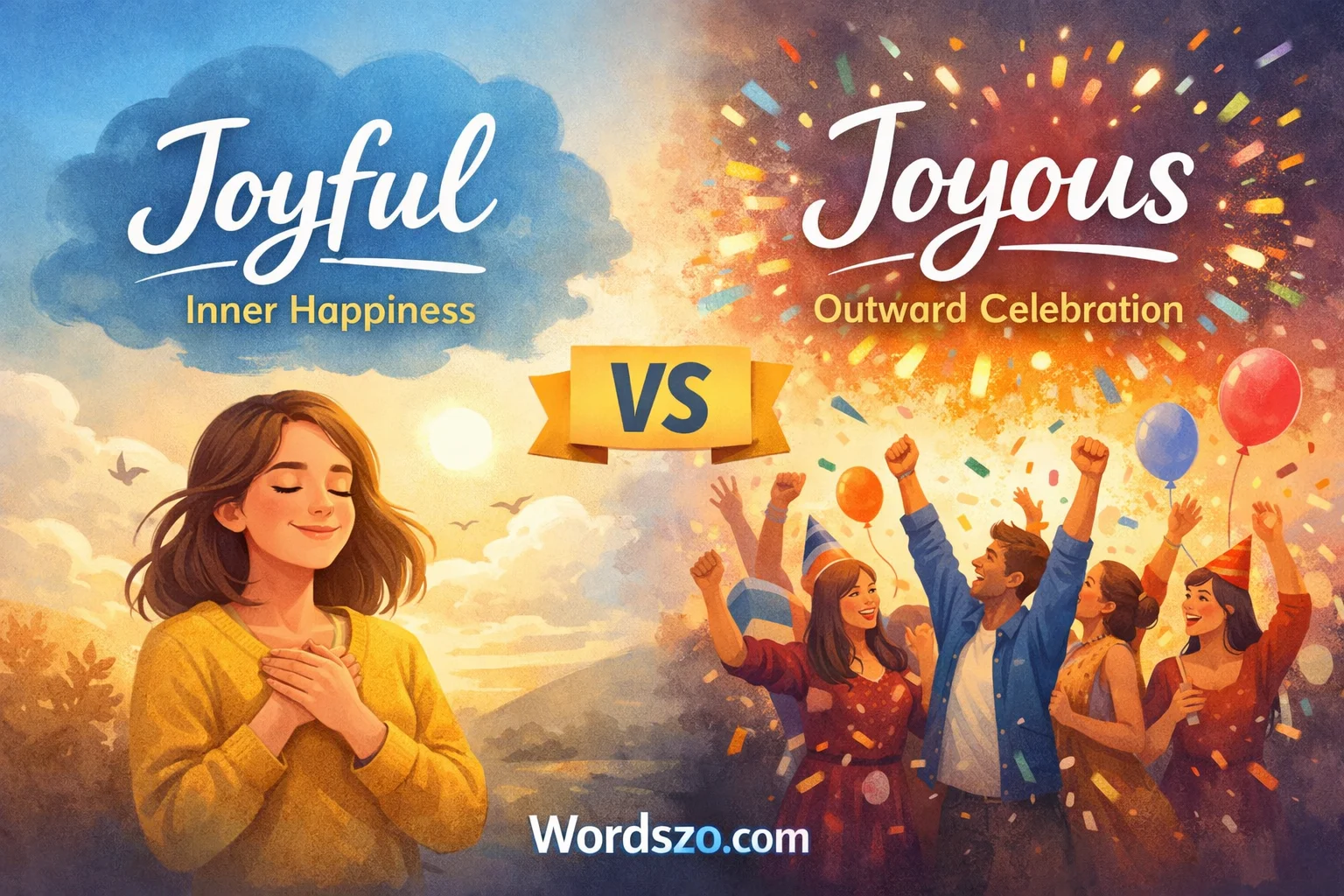
The word joyful describes a deep, personal feeling of happiness that comes from within. It often reflects an inner emotional state rather than an outward celebration.
Meaning
Joyful means feeling or expressing true joy, contentment, or heartfelt happiness. It suggests a calm yet powerful emotional satisfaction.
How It’s Used
In the joyful vs joyous comparison, joyful is typically used to describe:
- A person’s emotional state
- A mindset or attitude
- A meaningful or lasting happiness
It often appears in emotional, reflective, spiritual, or personal writing.
Where It’s Used
- Common in both American and British English
- Frequently used in literature, personal essays, religious texts, and motivational writing
- Grammatically, it functions as an adjective
Examples in Sentences
- She felt joyful when she finally achieved her dream.
- His face wore a joyful smile after hearing the news.
- The room was filled with a joyful sense of peace.
Each example shows joyful as an internal, emotional experience.
Short Historical or Usage Note
The word joyful dates back to Middle English and comes from joy + -ful, meaning “full of joy.” Historically, it has always carried a personal and emotional tone, making it ideal for heartfelt expression.
What Is “Joyous”?
The word joyous focuses on visible, outward expressions of happiness, often tied to events or shared moments.
Meaning
Joyous describes something that creates joy, appears celebratory, or feels lively and festive. It emphasizes expression rather than inner emotion.
How It’s Used
In the joyful vs joyous discussion, joyous is often used to describe:
- Events or occasions
- Celebrations and gatherings
- Atmospheres filled with excitement
It leans toward external happiness rather than personal feelings.
Where It’s Used
- Common in formal writing, storytelling, speeches, and descriptions
- Used in both US and UK English
- Functions as an adjective
Examples in Sentences
- The wedding was a joyous occasion for everyone.
- Laughter filled the hall during the joyous celebration.
- They shared a joyous reunion after many years apart.
Here, joyous highlights shared happiness and visible excitement.
Spelling and Usage Note
Unlike joyful, joyous ends with -ous, a suffix often used to describe qualities or states, such as famous or glorious. This gives it a slightly more formal and descriptive tone.
Key Differences Between Joyful and Joyous
Understanding joyful vs joyous becomes much easier when you focus on emotion vs expression.
Quick Bullet-Point Differences
- Joyful = inner, personal happiness
- Joyous = outward, expressive celebration
- Joyful feels calm and emotional
- Joyous feels energetic and festive
- Joyful often describes people
- Joyous often describes events or moments
Comparison Table
| Feature | Joyful | Joyous |
|---|---|---|
| Emotional Focus | Inner feeling | Outward expression |
| Tone | Calm, heartfelt | Energetic, celebratory |
| Common Usage | Personal emotions | Events and occasions |
| Writing Style | Reflective, emotional | Descriptive, expressive |
| Example | A joyful heart | A joyous celebration |
This table clearly shows how joyful vs joyous differs in practical use.
Real-Life Conversation Examples
Dialogue 1
A: “Was the festival fun?”
B: “Yes, it was truly joyous!”
🎯 Lesson: Use joyous for lively events.
Dialogue 2
A: “How did you feel after helping them?”
B: “I felt deeply joyful.”
🎯 Lesson: Use joyful for inner emotions.
Dialogue 3
A: “Your wedding photos look amazing.”
B: “It was a joyous day for everyone.”
🎯 Lesson: Celebrations = joyous.
Dialogue 4
A: “Why do you always seem calm lately?”
B: “I’ve learned to live a more joyful life.”
🎯 Lesson: Long-term happiness = joyful.
Dialogue 5
A: “Why not say joyful party?”
B: “Because parties are joyous, feelings are joyful.”
🎯 Lesson: Match the word to the context.
When to Use Joyful vs Joyous
Choosing between joyful vs joyous depends on what you’re describing.
Use “Joyful” When:
- Referring to personal emotions
- Describing a mindset or inner peace
- Writing emotional or reflective content
Memory Trick:
👉 Joyful = you feel it
Use “Joyous” When:
- Talking about celebrations or events
- Describing shared happiness
- Writing vivid, expressive descriptions
Memory Trick:
👉 Joyous = you see it
US vs UK Writing
There is no regional spelling difference between joyful vs joyous. Both words are used the same way in American and British English, making them universally safe choices.
Fun Facts or History
✨ Fun Fact 1:
The word joyous often appears in classic literature to describe festivals, victories, and royal events.
✨ Fun Fact 2:
Joyful is more commonly used in psychology and self-help writing because it reflects emotional well-being rather than excitement.
Conclusion
The difference between joyful vs joyous is subtle but powerful. Joyful speaks to inner happiness, emotional fulfillment, and personal peace, while joyous captures outward celebration, shared excitement, and lively moments. Both words express happiness, but they do so in different ways.
By understanding their tone, context, and emotional depth, you can choose the perfect word every time. This small distinction can elevate your writing, make your message clearer, and help you sound more natural and confident.
Next time someone uses these two words, you’ll know exactly what they mean! 😊