
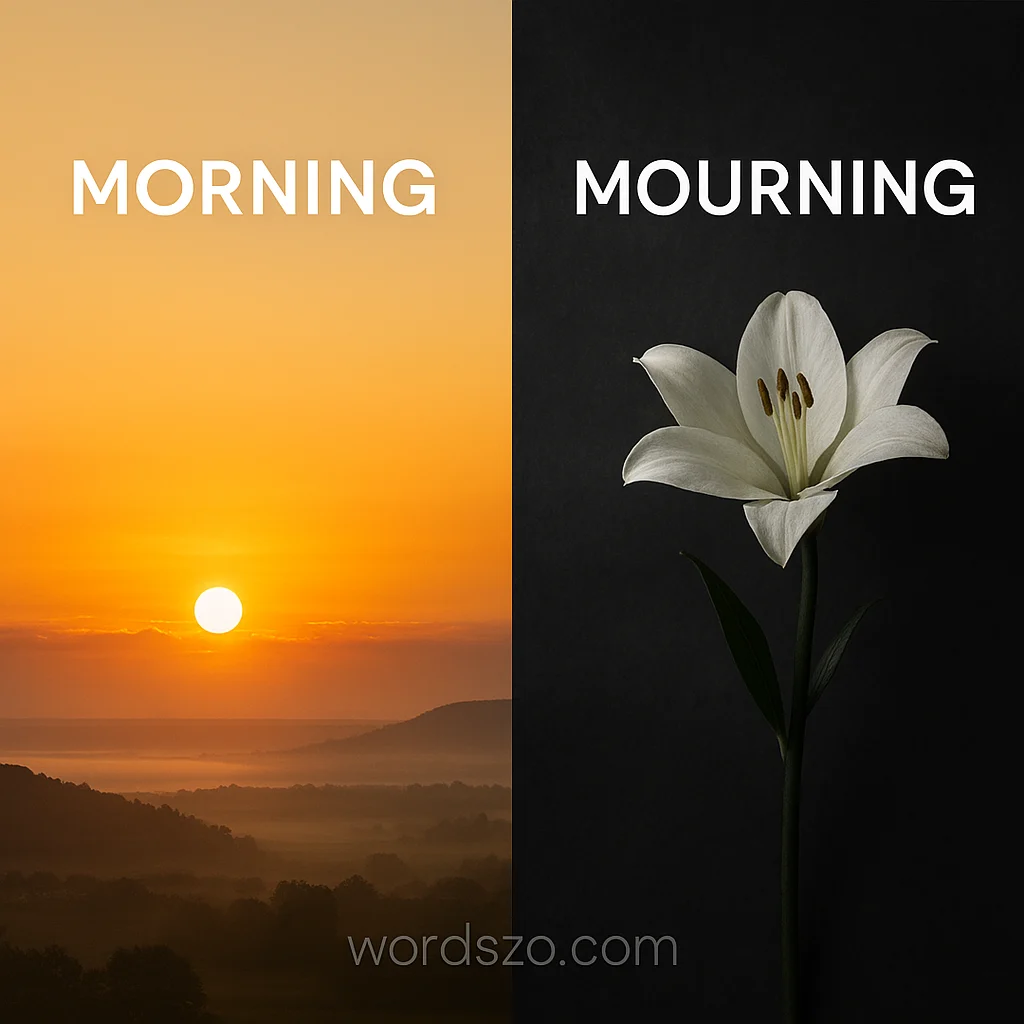
If you have ever stopped to second-guess your spelling while writing about the start of your day or the loss of a loved one, you aren’t alone. The words morning and mourning are homophones, meaning they sound exactly the same but carry entirely different meanings and spellings. This linguistic quirk often leads to awkward typos in emails, social media posts, and even professional documents.
Understanding the distinction is vital for clear communication. While one refers to a period of time, the other describes a deeply personal emotional process. Although they look and sound similar, they serve completely different purposes. In this guide, we will break down the definitions, historical roots, and grammatical rules for morning and mourning so you can write with absolute confidence. Let’s clear up the confusion for good! ✍️☀️
Section 1: What Is “Morning”?
The word morning is a noun that refers to the earliest part of the day. Generally, it encompasses the time from sunrise until noon. It is the period when the sun begins its ascent, and most of the world wakes up to start their daily routines.
Meaning and Usage
In everyday English, morning is used to denote a specific timeframe. It is the foundation of many greetings and scheduled activities. Grammatically, it functions as a noun, though it can act as an attributive noun (an adjective-like role) when it modifies another noun, such as in “morning coffee.”
Where It’s Used
There are no regional differences between American and British English for this word; morning is the universal spelling across the globe. Whether you are in London, New York, or Sydney, the start of the day is always the morning.
Examples in Sentences
- “I love the smell of fresh coffee in the morning.”
- “She goes for a three-mile run every morning before work.”
- “The morning sun felt warm against the windowpane.”
- “We have a team meeting scheduled for tomorrow morning.”
Historical Note
The word morning evolved from the Middle English word morwenning. This was derived from morn, which originally meant “tomorrow” or “dawn.” Over centuries, the “ing” suffix was added, mirroring words like “evening,” to create a standardized way of describing parts of the day.
Section 2: What Is “Mourning”?
The word mourning is a noun and a verb (the present participle of mourn). It refers to the expression of deep sorrow, typically following a death. It isn’t just the internal feeling of sadness; it often refers to the outward signs or the period during which one grieves.
Meaning and Usage
Mourning describes the act of feeling or showing grief. It can refer to the emotional process of lamenting a loss or the cultural customs associated with death, such as wearing black clothing or holding a vigil. While morning is about time, mourning is about the heart.
Where It’s Used
Like its counterpart, mourning is used universally across all English dialects. The spelling remains consistent in both US and UK English. It is frequently used in funeral contexts, historical accounts of grieving royalty, or personal reflections on loss.
Examples in Sentences
- “The entire nation was in a state of mourning after the leader passed away.”
- “She is still mourning the loss of her beloved pet.”
- “The widow wore a black veil as a sign of mourning.”
- “It takes time to move through the stages of mourning.”
Usage Note
Note the “u” in mourning. A helpful way to distinguish it from the time of day is to think of the “u” standing for “unhappy” or “upset.” This distinguishes the grief-related word from the sun-related one.
Key Differences Between Morning and Mourning
Understanding the nuances between these two words is easier when you see them side-by-side.
Quick Summary Points
- Morning (no ‘u’) refers to the time between dawn and noon.
- Mourning (with a ‘u’) refers to the expression of grief or sorrow.
- Morning is almost always a noun.
- Mourning can be a noun (a period of mourning) or a verb (he is mourning).
- They are homophones, so they sound identical when spoken aloud.
Comparison Table
| Feature | Morning | Mourning |
| Primary Meaning | The start of the day (dawn to noon). | The expression of grief or sorrow. |
| Part of Speech | Noun | Noun or Verb |
| Common Usage | Greetings, schedules, time of day. | Funerals, loss, emotional recovery. |
| Spelling Tip | Think of “Morning Sun.” | Think of “U” for “Unhappy.” |
| Example | “Good morning, how are you?” | “He is mourning his friend.” |
Real-Life Conversation Examples
Dialogue 1
A: “I missed the 8 AM meeting because I slept through my alarm.”
B: “That’s a rough start to your morning.”
A: “Tell me about it, I need a double espresso.”
🎯 Lesson: Use morning when referring to the clock or the start of your daily schedule.
Dialogue 2
A: “Why is the flag at the post office flying at half-staff?”
B: “The city is in mourning for the former mayor who died last night.”
A: “Oh, I hadn’t heard the news. That’s very sad.”
🎯 Lesson: Use mourning when discussing public or private displays of grief.
Dialogue 3
A: “I’m sorry I haven’t called back; I’ve been mourning my grandfather.”
B: “Please don’t apologize. Take all the time you need.”
A: “Thank you, I’ll try to reach out again tomorrow morning.”
🎯 Lesson: This shows both words in action—one for the emotional state (mourning) and one for the time of day (morning).
Dialogue 4
A: “Is ‘mourning’ spelled with a ‘U’ when I’m talking about the birds singing?”
B: “No, that’s just the morning birds. Unless the birds are sad!”
A: “Right! ‘U’ is for the sad stuff.”
🎯 Lesson: Morning is for nature and time; mourning is for sorrow.
When to Use Morning vs Mourning
Practical Usage Rules
- Check the Clock: If you can replace the word with “AM,” use morning.
- Check the Mood: If the context involves a funeral, a loss, or crying, use mourning.
- The “U” Rule: If there is a sense of “Unfortunate” loss, add the “U” for mourning.
Simple Memory Tricks
- Morning = More Organized Routines Now.
- Mourning = Many Others Understand Real Negativity.
Writing for US vs UK
Fortunately, you don’t have to worry about regional spelling differences here. Both American English and British English use morning for time and mourning for grief. Whether you are writing for a blog in London or a newspaper in Los Angeles, the rules remain the same.
Fun Facts or History Section
- The Mourning Cloak Butterfly: There is a beautiful species of butterfly called the “Mourning Cloak.” It gets its name because its dark wings, bordered by bright spots, resemble a traditional cloak a person might wear while in mourning.
- The Mourning Dove: Many people mistake the “Mourning Dove” for a “Morning Dove.” While they are active in the morning, they are actually named for their “mournful” cooing sound, which sounds like a person crying or mourning.
Conclusion
Distinguishing between morning and mourning is a hallmark of a careful writer. While the words sound identical, using the wrong one can significantly change the tone of your sentence. Remember that morning belongs to the sun and the start of a new day, while mourning belongs to the heart and the process of healing after a loss. By keeping the “U” for “unhappy” or “upset” in mind, you will never mix these two up again. Next time someone uses these two words, you’ll know exactly what they mean!