Have you ever come across the words preceding and proceeding and wondered why they seem so similar yet feel completely different? Many English speakers, even native ones, get confused when choosing which word to use. Both words sound alike, look almost identical, and are often mixed up in writing or conversation.
Although they look and sound similar, they serve completely different purposes. Understanding the difference is essential for writing clearly, sounding professional, and avoiding common grammatical mistakes. In this guide, you’ll learn exactly how to use preceding and proceeding, their meanings, grammar rules, regional usage, practical examples, and an easy comparison to remember forever.
What Is “Preceding”?
Meaning:
Preceding is the present participle of the verb precede. It refers to something that comes before another event, thing, or time.
Where and How “Preceding” Is Used:
- Used primarily in formal and academic English.
- Commonly appears in writing, reports, and storytelling to indicate order.
- Grammatically, it is used as an adjective or verb (present participle).
Examples in Sentences:
- “In the preceding chapter, we discussed the causes of climate change.”
- “The events of the preceding week were very stressful.”
- “He apologized for his behavior in the preceding meeting.”
Short Historical/Usage Note:
The word precede comes from the Latin praecedere, meaning “to go before.” Its usage has been consistent in English for centuries to denote order or sequence.
What Is “Proceeding”?
Meaning:
Proceeding is the present participle of the verb proceed. It means to continue, go forward, or begin an action or process.
Where and How “Proceeding” Is Used:
- Used in both formal and everyday English.
- Appears in legal, business, and casual contexts to describe an ongoing process.
- Grammatically, it is a verb (present participle) or noun (plural form: proceedings).
Examples in Sentences:
- “After the brief pause, the meeting proceeded as planned.”
- “The construction is proceeding smoothly despite the weather.”
- “Court proceedings lasted all afternoon.”
Short Historical/Usage Note:
The word proceed comes from Latin procedere, meaning “to go forward.” It emphasizes action, continuation, or progress.
Key Differences Between Preceding and Proceeding
Understanding the differences becomes easy when you look at them side by side:
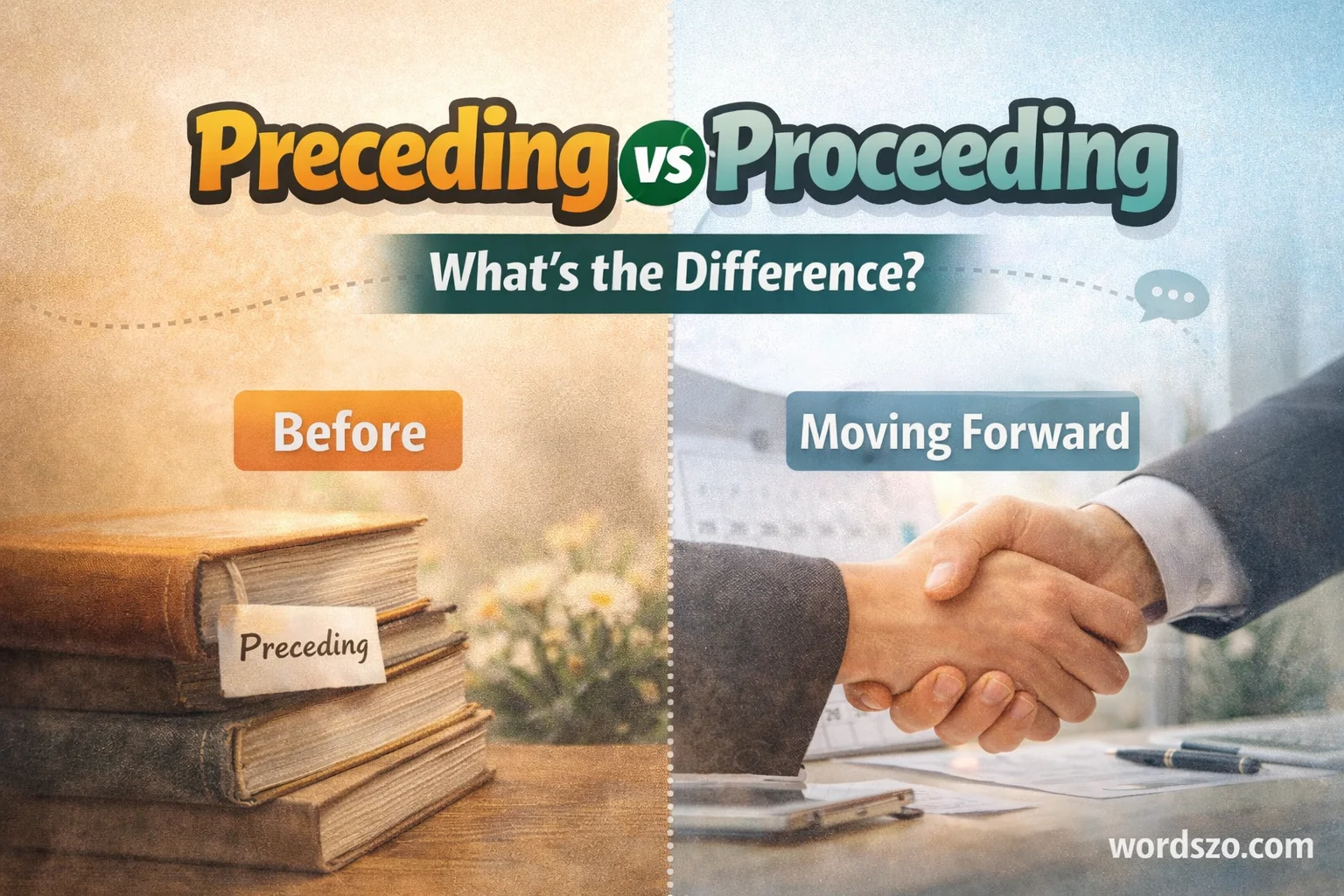
- Preceding = comes before; Proceeding = moving forward or continuing.
- Preceding is about order or sequence. Proceeding is about action or progress.
- Preceding can describe time, events, or things. Proceeding can describe actions, events, or legal/business processes.
- Preceding is often used in writing or formal reports. Proceeding is used in both formal and casual contexts.
Comparison Table: Preceding vs Proceeding
| Feature | Preceding | Proceeding |
|---|---|---|
| Meaning | Coming before | Moving forward, continuing |
| Verb Root | Precede | Proceed |
| Usage Context | Formal, academic, storytelling | Formal, legal, business, casual |
| Part of Speech | Adjective / Verb (present participle) | Verb (present participle) / Noun (proceedings) |
| Time Reference | Refers to something in the past | Refers to ongoing or future action |
| Examples | “In the preceding chapter…” | “The meeting is proceeding as planned.” |
Real-Life Conversation Examples
Dialogue 1
A: “Did you read the preceding section of the report?”
B: “Yes, it explains the background before the main discussion.”
🎯 Lesson: Preceding refers to something that comes first or before.
Dialogue 2
A: “Are the legal proceedings finished yet?”
B: “No, they are still ongoing.”
🎯 Lesson: Proceeding describes an action that continues or is happening.
Dialogue 3
A: “What happened in the preceding week?”
B: “We had three important meetings and a project review.”
🎯 Lesson: Preceding points to past events or order.
Dialogue 4
A: “Can we proceed with the plan?”
B: “Yes, everything is ready to start.”
🎯 Lesson: Proceeding emphasizes moving forward or beginning.
Dialogue 5
A: “The preceding examples were confusing.”
B: “Let’s clarify them before proceeding to the next topic.”
🎯 Lesson: Preceding relates to what came before; proceeding relates to what is happening next.
When to Use Preceding vs Proceeding
Practical Usage Rules:
- Use preceding when referring to something that came before another thing.
- Use proceeding when referring to an action that is ongoing or about to start.
Memory Tricks:
- Pre = Before → Preceding
- Pro = Forward → Proceeding
Writing for US vs UK:
- Both preceding and proceeding are spelled the same in American and British English.
- Differences are mainly contextual, not regional.
Fun Facts & History
- Preceding in Literature: Many classic novels use preceding to guide readers through chapters or events in chronological order.
- Proceedings in Law: In legal English, “proceedings” can refer to the full record of court actions, an important technical term in both UK and US law.
Conclusion
The difference between preceding and proceeding is straightforward once you remember the simple rule: preceding = comes before, proceeding = moving forward. Preceding refers to past events, order, or things that happen first, while proceeding relates to ongoing actions, events, or processes. By understanding this, you can write clearly, sound professional, and avoid confusion.
Next time you encounter these two words, you’ll know exactly which one to use!