Introduction
Choosing an investment platform can feel overwhelming, especially when two industry giants dominate the conversation. Schwab and Vanguard are often mentioned in the same breath, leading many investors to assume they are nearly identical. Both are trusted, low-cost, and beginner-friendly—but they are not the same. The confusion usually comes from their shared focus on long-term investing, index funds, and investor education. Although they look/sound similar, they serve completely different purposes. Understanding Schwab vs Vanguard goes beyond fees and fund names—it’s about investment philosophy, platform flexibility, and how hands-on you want to be. In this guide, we’ll break down what each company offers, how they differ, and which one is the better fit for your financial goals.
What Is “Schwab”?
Charles Schwab is a full-service brokerage firm that offers a wide range of investment products, trading tools, and financial services. It is known for flexibility, accessibility, and advanced trading features.
Clear Meaning
Schwab is a brokerage platform that allows investors to trade stocks, ETFs, mutual funds, bonds, options, and more—all from a single account.
How It’s Used
Schwab is commonly used by:
- Active traders
- Long-term investors
- Retirement planners
- DIY investors who want control
Where It’s Used
Schwab is based in the United States but serves international investors as well. It follows standard US financial regulations and tax structures.
Examples in Sentences
- “I use Schwab for my retirement and taxable brokerage accounts.”
- “Schwab offers commission-free stock trading.”
- “Many investors prefer Schwab for its research tools.”
Short Historical Note
Founded in 1971, Charles Schwab disrupted traditional brokerage models by lowering fees and empowering individual investors. Today, it is one of the largest brokerage firms in the world.
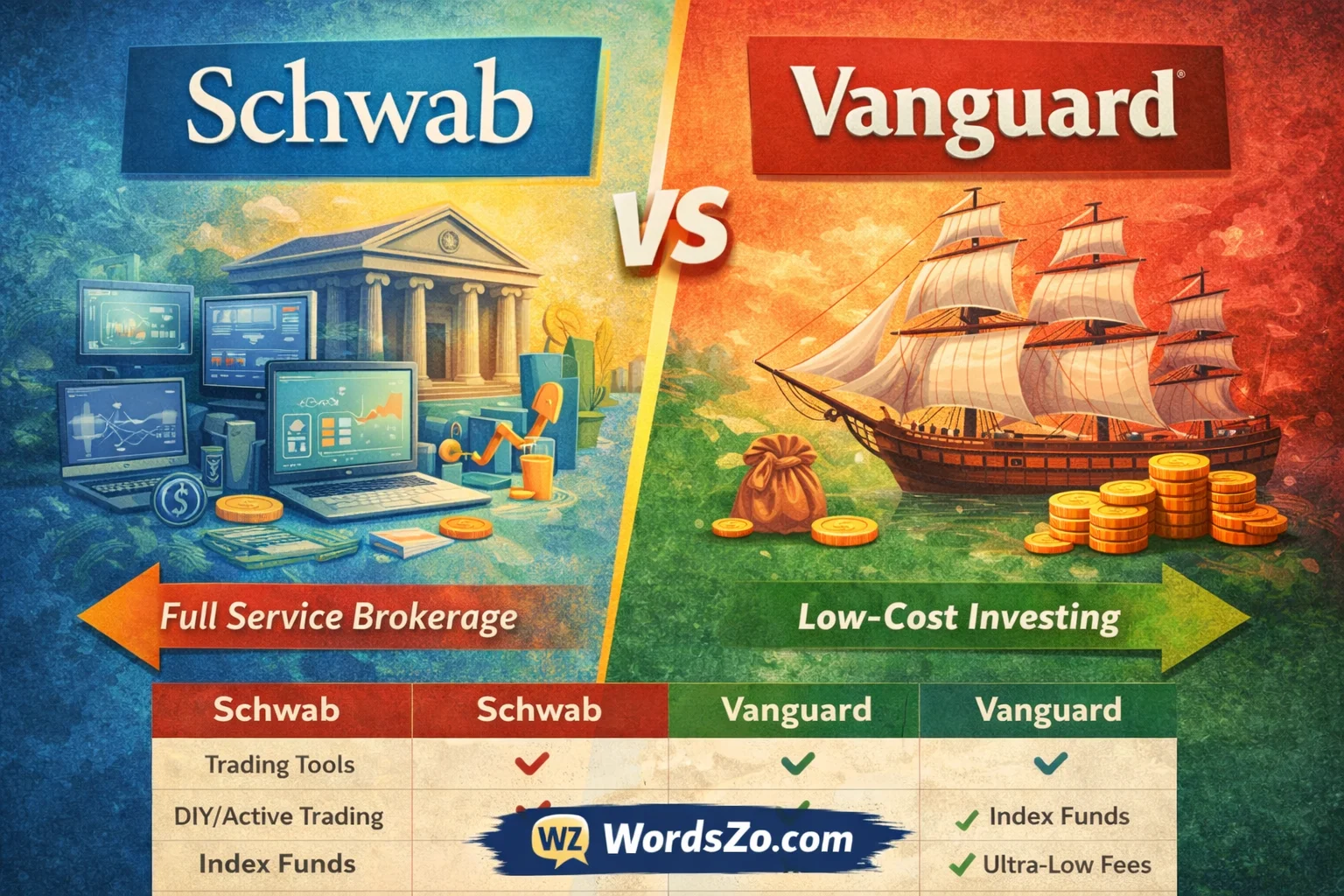
In the Schwab vs Vanguard comparison, Schwab represents flexibility and full-service investing.
What Is “Vanguard”?
Vanguard is an investment management company best known for pioneering low-cost index funds and a passive investing philosophy.
Clear Meaning
Vanguard primarily focuses on long-term, buy-and-hold investing, especially through index funds and ETFs.
How It’s Used
Vanguard is commonly used by:
- Passive investors
- Retirement savers
- Long-term wealth builders
- Cost-conscious investors
Where It’s Used
Vanguard operates mainly in the United States, with international branches in several countries. Its funds are widely held across global markets.
Examples in Sentences
- “I invest in Vanguard index funds for the long term.”
- “Vanguard is known for ultra-low expense ratios.”
- “Many 401(k) plans use Vanguard funds.”
Regional or Grammatical Notes
There are no spelling or usage differences. The name Vanguard is universally recognized in finance.
Short Historical Note
Founded in 1975 by John C. Bogle, Vanguard introduced the first index fund for individual investors. Its investor-owned structure is unique in the industry.
In Schwab vs Vanguard, Vanguard represents simplicity, discipline, and long-term thinking.
Key Differences Between Schwab and Vanguard
Bullet Point Summary
- Schwab offers a full-service brokerage experience
- Vanguard focuses on passive, long-term investing
- Schwab supports active trading and advanced tools
- Vanguard emphasizes low costs and simplicity
- Schwab is more customizable
- Vanguard is more philosophy-driven
Comparison Table (Mandatory)
| Feature | Schwab | Vanguard |
|---|---|---|
| Core Focus | Full-service brokerage | Passive investing |
| Best For | Active & DIY investors | Long-term investors |
| Trading Tools | Advanced & flexible | Basic |
| Index Funds | Yes | Yes (industry leader) |
| Expense Ratios | Low | Ultra-low |
| Account Types | Many options | Fewer, focused |
| Investor Philosophy | Choice & flexibility | Discipline & patience |
This table highlights why Schwab vs Vanguard is more about style than superiority.
Real-Life Conversation Examples
Dialogue 1
A: “I’m choosing between Schwab and Vanguard.”
B: “Do you want flexibility or simplicity?”
🎯 Lesson: Your investing style matters more than brand.
Dialogue 2
A: “Why does my advisor prefer Vanguard?”
B: “Because it’s ideal for long-term, low-cost investing.”
🎯 Lesson: Vanguard is built for passive investors.
Dialogue 3
A: “Schwab feels more customizable.”
B: “That’s why traders love it.”
🎯 Lesson: Schwab suits hands-on investors.
Dialogue 4
A: “Is Schwab more expensive than Vanguard?”
B: “Not necessarily—it depends on how you invest.”
🎯 Lesson: Costs depend on usage, not just platform.
When to Use Schwab vs Vanguard
Choose “Schwab” When:
- You want to trade stocks, ETFs, or options
- You like research tools and customization
- You plan to manage your portfolio actively
- You want all financial services in one place
Memory Trick:
👉 Schwab = Swiss Army knife of investing.
Choose “Vanguard” When:
- You prefer hands-off investing
- You believe in index funds and long-term growth
- You want minimal fees and simple choices
- You’re focused on retirement planning
Memory Trick:
👉 Vanguard = set it and forget it.
US vs UK (or Global) Considerations
Both Schwab and Vanguard are US-based. International investors should check account eligibility, tax rules, and local fund availability.
Fun Facts or History
- Vanguard is investor-owned. Its funds own the company, which helps keep costs low.
- Schwab removed trading commissions early. This move forced much of the industry to follow.
These facts show how Schwab vs Vanguard shaped modern investing.
Conclusion
The debate between Schwab vs Vanguard isn’t about which platform is better—it’s about which one is better for you. Schwab excels in flexibility, tools, and active investing options, while Vanguard shines in low-cost, long-term, passive investing. Both are trustworthy, well-established, and beginner-friendly in different ways. If you value control and variety, Schwab may be your best fit. If you value simplicity and discipline, Vanguard could be the smarter choice. Next time someone mentions these two platforms, you’ll know exactly what they mean!