Introduction
A confident smile can change how you look, feel, and even how others perceive you. That’s why cosmetic dental treatments like veneers and caps have become so popular worldwide. However, many people struggle to understand the difference between these two options. Some assume they’re the same thing, while others believe one is always better than the other — which isn’t true.
The confusion usually happens because both treatments improve the appearance of teeth and are performed by dentists. They can even look similar once placed. Although they look/sound similar, they serve completely different purposes.
In this detailed guide, we’ll clearly explain veneers vs caps, how they work, when each is used, and which option might suit your dental needs best. By the end, you’ll be able to make a confident, informed decision without second-guessing.
What Is “Veneers”?
Meaning of Veneers
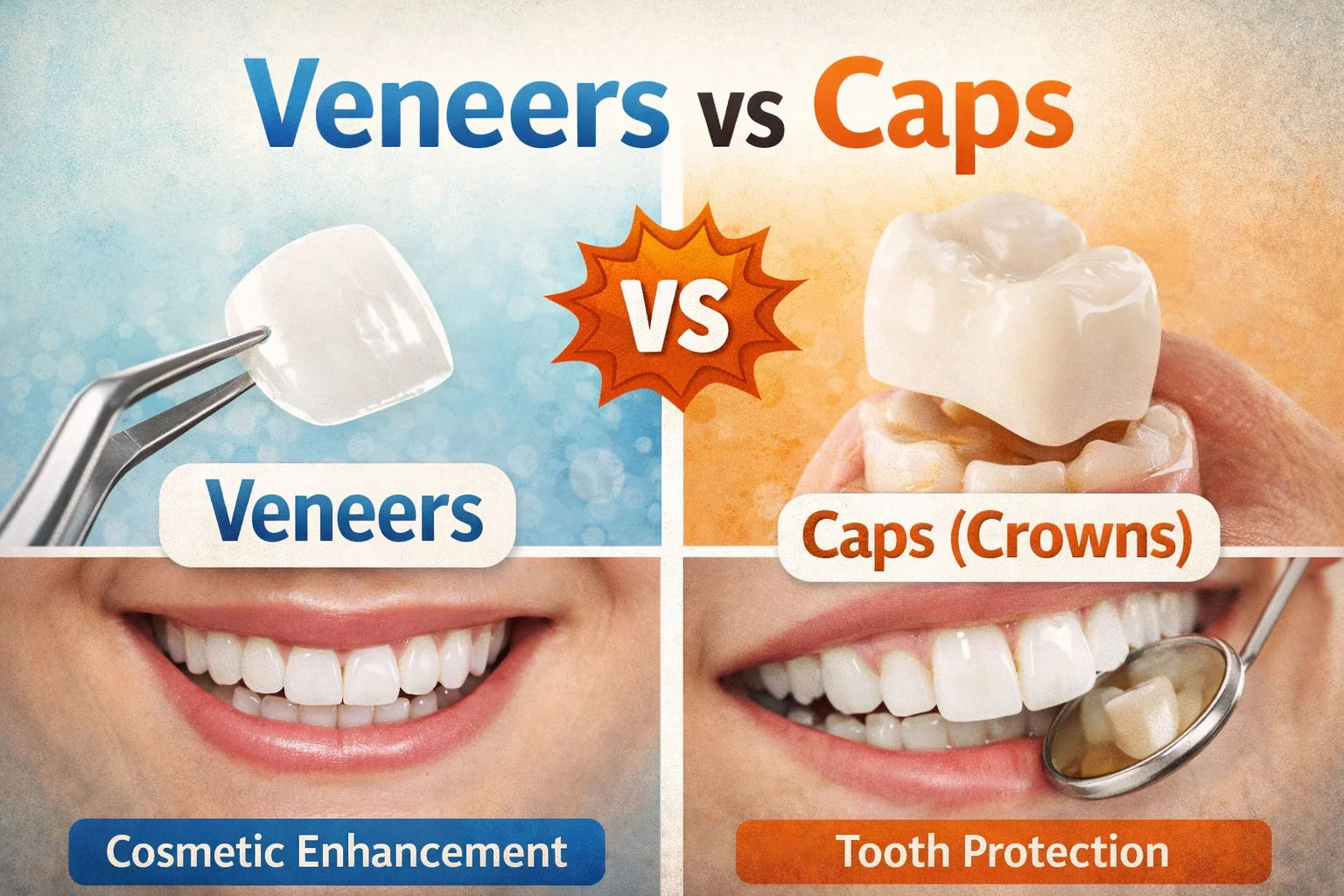
Veneers are thin, custom-made shells designed to cover the front surface of teeth. They are mainly used for cosmetic enhancement, improving the appearance of teeth rather than fixing major structural problems.
Veneers are usually made from porcelain or composite resin and are bonded permanently to the front of natural teeth.
How Veneers Are Used
Dentists use veneers to correct issues such as:
- Discolored or stained teeth
- Minor chips or cracks
- Slightly crooked or uneven teeth
- Small gaps between teeth
- Worn enamel
Veneers don’t replace the tooth — they enhance what’s already there.
Where Veneers Are Used
- Common in cosmetic dentistry
- Widely used in US, UK, Europe, and Asia
- Popular among celebrities and professionals
- Suitable for patients with generally healthy teeth
Examples in Context
- She chose veneers to brighten her smile.
- Dental veneers helped hide the gaps in his front teeth.
- Porcelain veneers last longer than composite ones.
Short Usage Note
Veneers require minimal tooth removal compared to caps. Because of this, they’re considered a conservative cosmetic option and are not ideal for heavily damaged teeth.
What Is “Caps”?
Meaning of Caps
Caps, medically known as dental crowns, are tooth-shaped covers that fully encase a damaged or weakened tooth. Unlike veneers, caps are used for both restorative and cosmetic purposes.
A cap protects the tooth from further damage while restoring its shape, size, strength, and appearance.
How Caps Are Used
Dentists recommend caps when a tooth:
- Is cracked or broken
- Has a large filling
- Is weak after a root canal
- Is severely worn or decayed
- Needs structural reinforcement
Caps cover the entire tooth, not just the front.
Where Caps Are Used
- Used worldwide in general and restorative dentistry
- Suitable for molars and front teeth
- Accepted in both medical and cosmetic treatments
Examples in Context
- He needed a cap after his root canal treatment.
- The dentist placed a ceramic cap on her molar.
- Caps protect weak teeth from breaking.
Regional or Grammatical Note
The term “cap” is commonly used in casual speech, while dentists often use “crown.” Both refer to the same treatment.
Key Differences Between Veneers and Caps
Quick Summary (Bullet Points)
- Veneers cover only the front surface
- Caps cover the entire tooth
- Veneers are mainly cosmetic
- Caps are restorative and cosmetic
- Veneers require less tooth reduction
- Caps provide stronger protection
- Veneers suit healthy teeth
- Caps suit damaged or weak teeth
Comparison Table: Veneers vs Caps
| Feature | Veneers | Caps (Crowns) |
|---|---|---|
| Coverage | Front surface only | Entire tooth |
| Purpose | Cosmetic | Restorative + Cosmetic |
| Tooth Reduction | Minimal | Moderate to extensive |
| Strength | Moderate | High |
| Used For | Color, shape, minor flaws | Damage, decay, weak teeth |
| Lifespan | 10–15 years | 15–20 years |
| Cost | Usually higher per tooth | Often slightly less |
| Best For | Smile enhancement | Tooth protection |
Real-Life Conversation Examples
Dialogue 1
Patient: “I just want whiter teeth.”
Dentist: “Veneers would be perfect for that.”
🎯 Lesson: Veneers are ideal for cosmetic improvements.
Dialogue 2
Patient: “My tooth cracked after a root canal.”
Dentist: “You’ll need a cap to protect it.”
🎯 Lesson: Caps strengthen weak teeth.
Dialogue 3
Friend: “Are veneers and caps the same?”
You: “No, veneers cover the front; caps cover everything.”
🎯 Lesson: Coverage is the biggest difference.
Dialogue 4
Patient: “Can veneers fix my broken tooth?”
Dentist: “A cap would be safer in your case.”
🎯 Lesson: Structural damage needs caps.
Dialogue 5
Colleague: “Why did you choose veneers?”
You: “My teeth were healthy — I just wanted a better smile.”
🎯 Lesson: Healthy teeth = veneers, damaged teeth = caps.
When to Use Veneers vs Caps
Choose Veneers When:
✔️ Teeth are healthy
✔️ You want cosmetic enhancement
✔️ Discoloration doesn’t respond to whitening
✔️ Minor shape or alignment issues exist
✔️ You want minimal tooth alteration
Examples:
- Smile makeover
- Closing small gaps
- Fixing chipped front teeth
Choose Caps When:
✔️ Teeth are damaged or weak
✔️ You had a root canal
✔️ Large fillings exist
✔️ Teeth need protection
✔️ Biting strength is required
Examples:
- Broken molars
- Severe decay
- Structural reinforcement
Simple Memory Trick
🦷 Veneers = Visual improvement
🦷 Caps = Complete coverage
If it’s about looks → Veneers
If it’s about strength → Caps
US vs UK Usage
Both veneers and caps are used the same way in US and UK English. However, professionals in both regions prefer the term “crown” instead of cap.
Fun Facts & History
1. Veneers Started in Hollywood
Veneers were first used in the 1920s to temporarily improve actors’ smiles during filming. Modern veneers are far more advanced and permanent.
2. Caps Are Over a Century Old
Dental crowns have existed for over 100 years, evolving from metal-only designs to today’s natural-looking ceramic crowns.
Conclusion
Understanding veneers vs caps is essential before choosing any dental treatment. Veneers are perfect for enhancing the appearance of healthy teeth, offering a brighter, more uniform smile with minimal alteration. Caps, on the other hand, provide strength and protection, making them the better choice for damaged or weakened teeth. Neither option is universally better — the right choice depends entirely on your dental condition and goals. Always consult a qualified dentist to evaluate your needs.
Next time someone asks about veneers or caps, you’ll know exactly which one does what!