Introduction
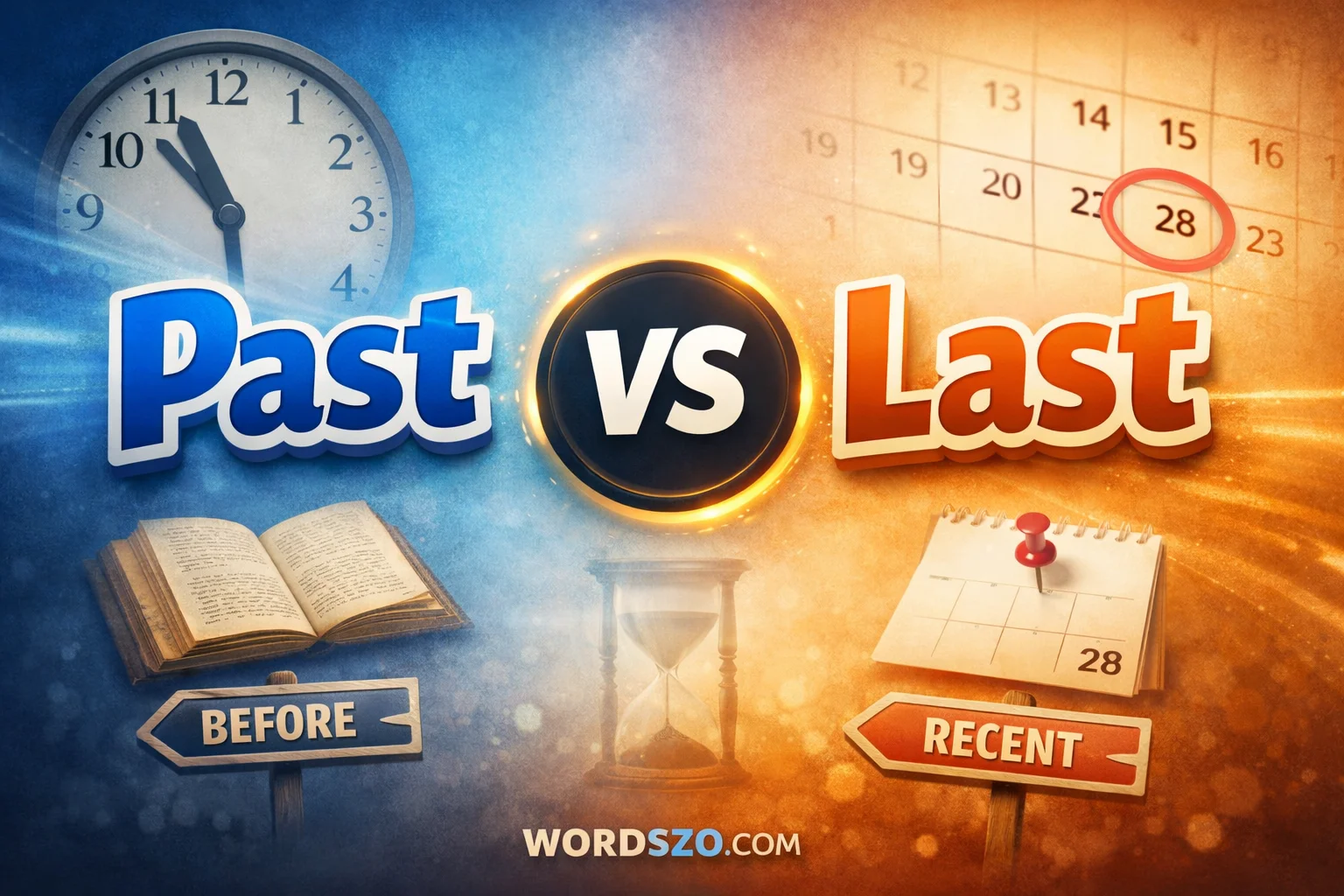
Have you ever paused mid-sentence wondering whether to say “past” or “last”? You’re not alone. These two words often confuse learners and even fluent speakers because they both relate to time and events that have already happened. At first glance, they seem interchangeable—but using the wrong one can subtly change your meaning.
The confusion mainly comes from their overlapping contexts. Both words are commonly used in everyday conversation, storytelling, and writing. However, their roles in grammar and meaning are quite different.
Although they look/sound similar, they serve completely different purposes.
In this complete guide on past vs last, you’ll learn what each word means, how to use them correctly, key differences, and simple tricks to avoid mistakes forever.
What Is “Past”?
The word past is one of the most flexible words in English. It can function as a noun, adjective, adverb, and preposition, depending on how you use it.
Meaning of Past
At its core, past refers to time that has already happened or something that is no longer current.
How “Past” Is Used
You can use past in several ways:
- As a noun: to refer to a period of time gone by
- As an adjective: to describe something earlier
- As a preposition: to show movement beyond something
- As an adverb: to indicate passing or going beyond
Examples of “Past” in Sentences
- “I learned a lot from my past mistakes.”
- “She walked past the store without stopping.”
- “This is a past event, not a current one.”
- “It’s half past five.”
Where “Past” Is Used
The word past is used in both British and American English with the same meanings and grammar rules. There’s no regional difference here.
Usage Note
Historically, past comes from Old English paest, meaning “gone by.” Over time, it evolved into a versatile word used across different grammatical roles.
Quick Insight for “Past vs Last”
In the debate of past vs last, remember that past focuses on time or movement beyond something, not a specific point.
What Is “Last”?
The word last is more straightforward compared to past, but it still plays an important role in expressing time and sequence.
Meaning of Last
Last refers to the most recent item, event, or time before the present, or the final one in a sequence.
How “Last” Is Used
- As an adjective: to describe something recent or final
- As a verb: to mean “to continue”
- As an adverb (informal): rarely used but possible
Examples of “Last” in Sentences
- “I saw him last night.”
- “This is the last chapter of the book.”
- “We met last week.”
- “The meeting didn’t last long.”
Where “Last” Is Used
Just like past, the word last is used in both American and British English with no spelling differences.
Usage Note
The word last comes from Old English laest, meaning “following after all others.” It has always been connected to sequence and finality.
Quick Insight for “Past vs Last”
When comparing past vs last, last always points to a specific time or final position, while past is broader.
Key Differences Between Past and Last
Understanding past vs last becomes easier when you break it down into clear differences.
Quick Bullet Points
- Past refers to any time before now, not specific
- Last refers to the most recent or final time/event
- Past can act as multiple parts of speech
- Last is mainly an adjective or verb
- Past can describe movement (e.g., walk past)
- Last focuses on sequence or order
Comparison Table: Past vs Last
| Feature | Past | Last |
|---|---|---|
| Meaning | Time before now / beyond something | Most recent or final |
| Specificity | General | Specific |
| Part of Speech | Noun, adjective, adverb, preposition | Adjective, verb |
| Time Usage | Broad past time | Exact previous time |
| Example | “In the past, life was simpler.” | “I called you last night.” |
| Movement Use | Yes (“walk past”) | No |
| Focus | Time or direction | Sequence or finality |
Real-Life Conversation Examples
Dialogue 1
A: “I met him past week.”
B: “Do you mean last week?”
A: “Yes, that’s what I meant!”
🎯 Lesson: Use last for specific recent time.
Dialogue 2
A: “She walked last me without speaking.”
B: “That sounds wrong—it should be past.”
A: “Oh, right!”
🎯 Lesson: Use past for movement beyond something.
Dialogue 3
A: “In the last, people didn’t use smartphones.”
B: “You mean in the past.”
A: “Got it!”
🎯 Lesson: Use past for general historical time.
Dialogue 4
A: “Was that your past chance?”
B: “You mean my last chance?”
A: “Yes!”
🎯 Lesson: Use last when referring to final opportunities.
Dialogue 5
A: “Time flew so fast this past weekend.”
B: “That’s actually correct!”
A: “Finally, I got one right!”
🎯 Lesson: Past can modify time expressions correctly.
When to Use Past vs Last
Mastering past vs last comes down to understanding specific vs general time.
Use “Past” When:
✔️ Talking about any time before now
✔️ Referring to history or earlier life
✔️ Describing movement beyond something
✔️ Using expressions like “half past five”
Examples:
- “In the past, people wrote letters.”
- “He ran past the finish line.”
- “The past year has been challenging.”
Use “Last” When:
✔️ Referring to a specific recent time
✔️ Talking about the final item in a sequence
✔️ Mentioning the most recent occurrence
Examples:
- “I spoke to her last night.”
- “This is the last chance.”
- “We met last month.”
Simple Memory Tricks
- Last = Latest (both start with L)
- Past = Previous time in general
- If you can replace it with “most recent” → use last
- If you mean “before now in general” → use past
US vs UK Usage
Good news—there’s no difference between American and British English for past vs last. The rules stay the same everywhere.
Fun Facts or History
1. “Past” Has More Roles Than You Think
Unlike many English words, past can act as four different parts of speech—making it one of the most flexible words in the language.
2. “Last” Can Also Mean Duration
While we focus on time order, last can also mean to continue, like in:
“The movie lasted three hours.”
Conclusion
Understanding past vs last is simpler than it first appears. While both relate to time, past refers to any time before now, and last points to the most recent or final event. The key difference lies in specificity—last is precise, while past is general.
Once you remember this distinction, your sentences will sound clearer and more natural. Keep practicing with real-life examples, and soon it will feel automatic.
Next time someone uses these two words, you’ll know exactly what they mean!