It’s easy to mix up perimeters and parameters. They sound almost identical, share similar spelling, and often appear in academic or professional writing. But here’s the truth: Although they look and sound similar, they serve completely different purposes.
One belongs to the world of geometry and measurement. The other is used in mathematics, statistics, programming, and everyday decision-making. Confusing them can make your writing look careless — especially in school papers, technical reports, or business communication.
In this clear and simple guide, we’ll break down perimeters vs parameters, explain their meanings, show real examples, and help you remember the difference easily.
Let’s get started.
What Is “Perimeters”?
Simple Definition
A perimeter is the total distance around the outside of a shape.
The plural form is perimeters.
If you imagine walking around the edge of a playground, garden, or building, the total distance you walk is the perimeter.
Where It’s Used
Perimeters are commonly used in:
- Geometry
- Architecture
- Construction
- Land measurement
- Fencing and landscaping
Example Sentences
- The perimeters of the two fields are different lengths.
- Security guards monitored the building’s outer perimeters.
- We calculated the perimeters before installing the fence.
Quick Math Example
If a rectangle has:
- Length = 10 meters
- Width = 5 meters
Perimeter = 2 × (Length + Width)
Perimeter = 2 × (10 + 5) = 30 meters
Word Origin
“Perimeter” comes from Greek roots:
- peri = around
- metron = measure
It literally means “measure around.”
What Is “Parameters”?
Simple Definition
A parameter is a limit, boundary, condition, or defining rule that shapes how something works.
The plural form is parameters.
Unlike perimeters, parameters are often abstract. They don’t measure physical space — they define rules or limits.
Where It’s Used
Parameters are common in:
- Mathematics
- Statistics
- Programming
- Business decisions
- Scientific research
- Everyday conversations
Example Sentences
- The project was completed within the given parameters.
- We must work within budget parameters.
- The function accepts two parameters.
In Mathematics and Statistics
In statistics, a parameter describes a characteristic of a population.
For example:
- The average income of a country is a population parameter.
- The true mean of a dataset is a parameter.
In Programming
In coding, parameters are variables passed into a function.
For example:
def greet(name):  # "name" is a parameter
    print("Hello", name)
Here, name is the parameter that defines what input the function accepts.
Word Origin
“Parameter” comes from Greek:
- para = beside
- metron = measure
It originally meant a measurable factor that defines something.
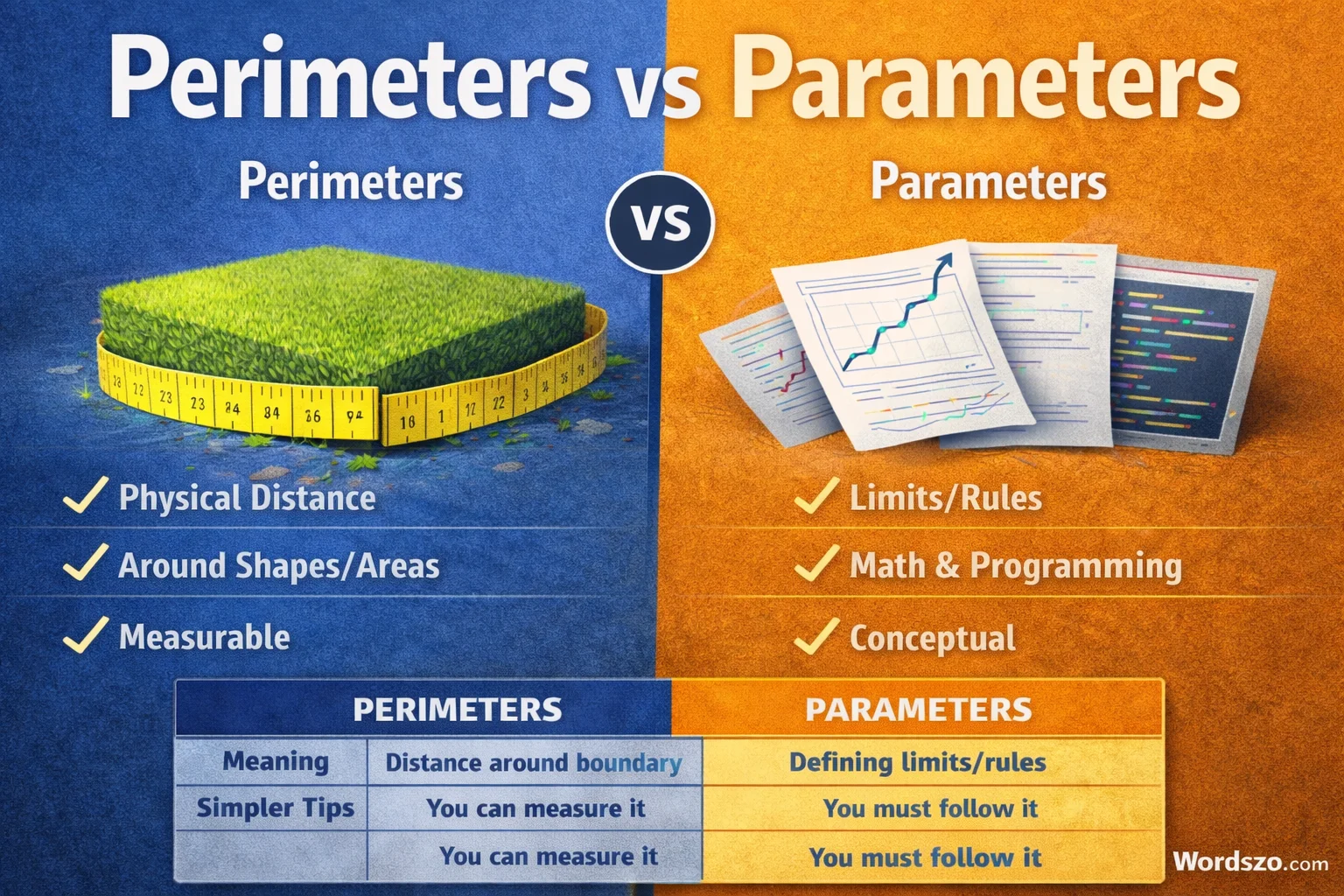
Perimeters vs Parameters: Side-by-Side Comparison
| Feature | Perimeters | Parameters |
|---|---|---|
| Meaning | Distance around a shape | Limits or defining conditions |
| Field | Geometry | Math, statistics, programming, business |
| Physical or Abstract? | Physical measurement | Often abstract |
| Example | Fence around a garden | Budget limits for a project |
Why People Confuse Perimeters and Parameters
There are three main reasons:
- They sound very similar.
- They share similar spelling.
- Both relate to boundaries — but in different ways.
Think of it this way:
- Perimeter = Physical boundary (something you can measure with a tape).
- Parameter = Conceptual boundary (rules or limits you set).
Easy Trick to Remember the Difference
Here’s a simple memory tip:
👉 Perimeter = Physical edge
Both start with “P” for Physical.
👉 Parameter = Policy or rule
Both relate to limits or conditions.
Real-Life Examples
Example 1: Construction
Incorrect:
“We must stay within the building perimeters of the budget.”
Correct:
“We must stay within the budget parameters.”
Example 2: Geometry Class
Incorrect:
“Calculate the parameters of the triangle.”
Correct:
“Calculate the perimeter of the triangle.”
When to Use Each Word
Use perimeters when talking about:
- Fences
- Walls
- Borders
- Shapes
- Land measurements
Use parameters when talking about:
- Rules
- Limits
- Guidelines
- Conditions
- Technical systems
Common Mistakes to Avoid
❌ Mixing them in professional writing
❌ Using “perimeters” when discussing policies
❌ Using “parameters” when measuring shapes
These errors can make technical writing look inaccurate.
Final Thoughts
Understanding the difference between perimeters vs parameters is simple once you break it down.
- Perimeters measure physical distance around something.
- Parameters define limits, rules, or boundaries in a system.
Although they look and sound similar, they belong to completely different contexts. Knowing when to use each word improves your clarity, professionalism, and confidence in writing.
Next time you’re unsure, just ask yourself:
👉 Are you measuring something you can walk around? Use perimeter.
👉 Are you setting limits or conditions? Use parameter.