
Introduction
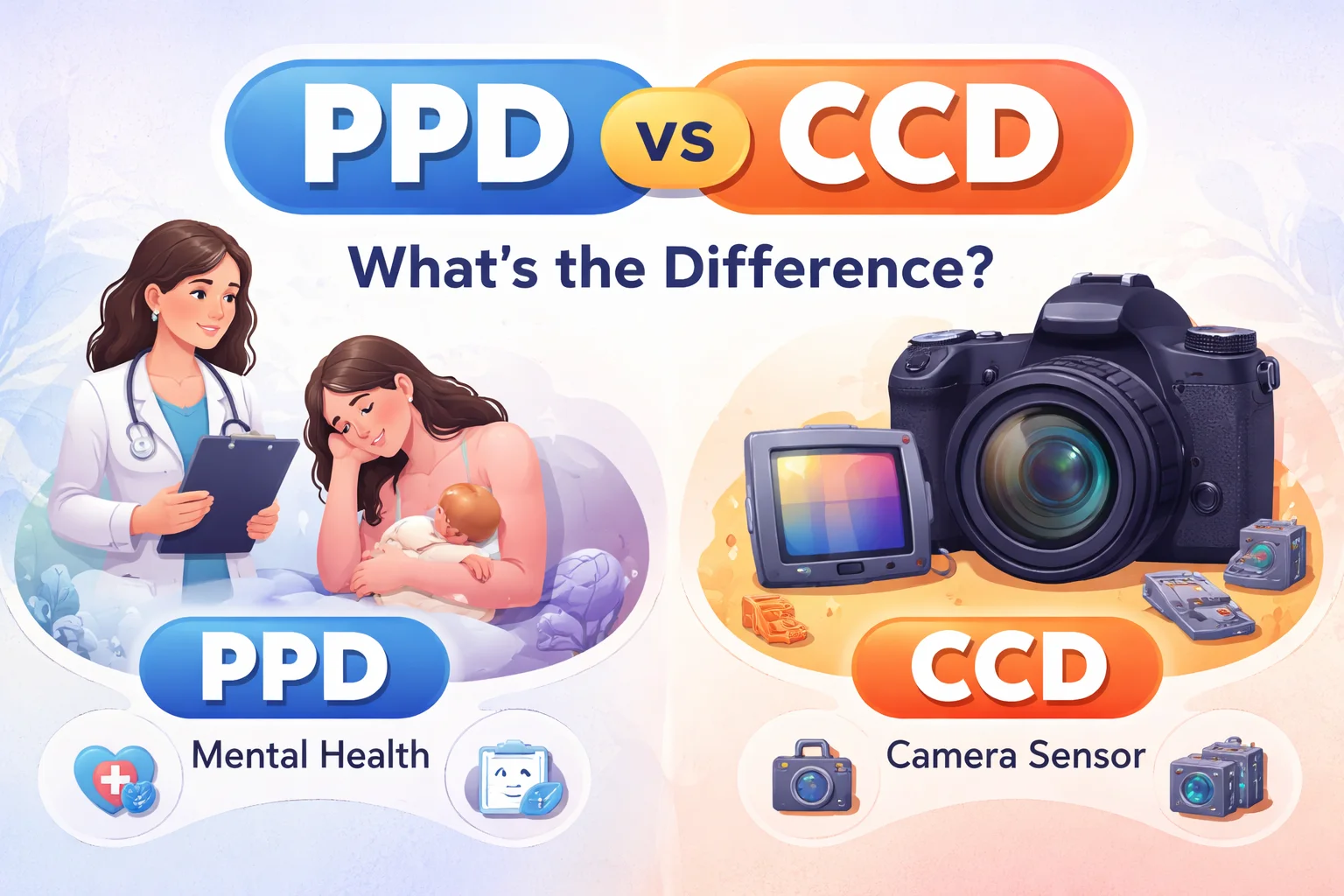
If you’ve ever come across the terms PPD and CCD, you might have paused and wondered what they actually mean. These abbreviations appear in completely different fields—from mental health to photography—yet they often confuse readers because they look similar and are used in technical contexts.
The confusion becomes even more common when people encounter them in articles, job roles, or medical discussions without proper explanation. One moment you’re reading about emotions, and the next, you’re seeing camera technology.
Although they look similar, they serve completely different purposes.
In this detailed guide on PPD vs CCD, you’ll learn what each term means, where they are used, how to avoid confusion, and practical examples to master their usage in real life.
What Is “PPD”?
Meaning of PPD
PPD most commonly stands for Postpartum Depression, a mental health condition that affects individuals after childbirth. However, depending on context, PPD can also mean:
- Purified Protein Derivative (used in tuberculosis testing)
- Pixels Per Degree (used in display technology and VR)
In this article, we’ll focus mainly on the most widely recognized meaning: Postpartum Depression.
How PPD Is Used
In healthcare and psychology, PPD refers to a serious emotional condition that can include:
- Persistent sadness
- Anxiety or mood swings
- Difficulty bonding with a baby
- Fatigue and low energy
It’s widely discussed in medical, parenting, and wellness contexts.
Where PPD Is Used
- Medical field (global usage)
- Psychology and counseling
- Parenting and maternal health discussions
The abbreviation PPD is universally recognized in English-speaking countries, including the US, UK, Canada, and Australia.
Examples in Sentences
- “She was diagnosed with PPD after her child was born.”
- “Awareness about PPD is increasing worldwide.”
- “Doctors recommend early screening for PPD symptoms.”
Historical / Usage Note
The term Postpartum Depression gained widespread recognition in the late 20th century as mental health awareness improved. Today, PPD is a critical topic in maternal healthcare, emphasizing emotional well-being after childbirth.
What Is “CCD”?
Meaning of CCD
CCD stands for Charge-Coupled Device, a type of image sensor used in digital imaging technology.
It converts light into electronic signals, making it essential in:
- Digital cameras
- Scientific imaging
- Astronomy equipment
How CCD Is Used
In photography and electronics, CCD sensors capture light and transform it into high-quality images. They are known for:
- High image quality
- Low noise
- Accurate color reproduction
Although newer technologies like CMOS sensors are now more common, CCD still holds importance in specialized applications.
Where CCD Is Used
- Photography and videography
- Medical imaging equipment
- Astronomy and scientific research
- Security cameras (older systems)
Examples in Sentences
- “This camera uses a CCD sensor for better image clarity.”
- “Astronomers rely on CCD technology for deep-space imaging.”
- “Older digital cameras often used CCD instead of CMOS.”
Regional / Technical Notes
Unlike PPD, which is tied to healthcare, CCD is purely a technical term used globally in engineering and imaging industries. There are no regional spelling differences—usage is consistent worldwide.
Key Differences Between PPD and CCD
Quick Summary
- PPD relates mainly to mental health or medical testing
- CCD relates to digital imaging technology
- PPD is about people and health
- CCD is about devices and electronics
- They belong to completely different industries
Comparison Table
| Feature | PPD | CCD |
|---|---|---|
| Full Form | Postpartum Depression (common) | Charge-Coupled Device |
| Field | Medical / Psychology | Technology / Electronics |
| Usage Context | Mental health, childbirth | Cameras, imaging devices |
| Type | Condition or test | Hardware component |
| Global Usage | Healthcare worldwide | Tech industry worldwide |
| Example | “She is recovering from PPD.” | “This camera has a CCD sensor.” |
| Focus | Human health | Image processing |
Real-Life Conversation Examples
Dialogue 1
A: “I read an article about PPD yesterday.”
B: “Oh, about camera sensors?”
A: “No, it was about postpartum depression.”
🎯 Lesson: Always check context—PPD vs CCD belong to completely different topics.
Dialogue 2
A: “This old camera has a CCD.”
B: “Is that a medical term?”
A: “No, it’s related to image sensors.”
🎯 Lesson: CCD is strictly a technology term, not medical.
Dialogue 3
A: “My doctor mentioned PPD during the checkup.”
B: “That sounds serious.”
A: “Yes, it’s about mental health after childbirth.”
🎯 Lesson: PPD is used in healthcare, especially maternal health.
Dialogue 4
A: “Why do photographers talk about CCD?”
B: “Because it affects image quality.”
A: “Got it—nothing to do with PPD then!”
🎯 Lesson: CCD is about devices, while PPD is about people.
Dialogue 5
A: “I mixed up PPD and CCD in my report.”
B: “That’s a big difference!”
A: “Yeah, one is medical and the other is tech.”
🎯 Lesson: Never interchange PPD vs CCD—they are unrelated.
When to Use PPD vs CCD
Use “PPD” When:
- Talking about mental health after childbirth
- Discussing medical tests (like TB screening)
- Writing about psychology or healthcare topics
Examples:
- “PPD affects many new mothers.”
- “Doctors are trained to identify PPD early.”
Use “CCD” When:
- Discussing camera technology
- Writing about image sensors or electronics
- Explaining scientific imaging systems
Examples:
- “The CCD sensor improves low-light performance.”
- “CCD cameras are used in laboratories.”
Simple Memory Trick
- PPD = People & Psychology
- CCD = Camera & Circuits
This quick trick makes PPD vs CCD easy to remember instantly.
US vs UK Usage
There are no spelling or regional differences for PPD vs CCD. Both abbreviations are used globally with the same meanings.
However:
- PPD is more common in healthcare discussions
- CCD is more common in technical and engineering fields
Fun Facts or History
1. PPD Awareness Has Grown Rapidly
In recent years, awareness campaigns and healthcare initiatives have made PPD a widely discussed topic, reducing stigma around mental health after childbirth.
2. CCD Changed Photography Forever
Before modern smartphone cameras, CCD sensors played a major role in the digital photography revolution, enabling high-quality images in early digital cameras.
Conclusion
Understanding the difference between PPD vs CCD is easier once you recognize their fields. PPD is primarily related to mental health and medical contexts, especially postpartum depression, while CCD belongs to the world of technology and imaging sensors.
They may look similar as abbreviations, but their meanings are completely unrelated. One focuses on human well-being, and the other powers digital imaging devices.
By remembering their core uses and contexts, you’ll never mix them up again. Next time someone uses these two words, you’ll know exactly what they mean!