
Introduction
If you’ve ever looked at a power outlet, appliance label, or voltage rating, you’ve probably seen 110V and 120V used almost interchangeably. This often leaves people wondering: are they the same thing, or is there a real difference?
The confusion usually comes from how electricity is described in everyday language versus how it’s actually delivered in modern systems. Many people still say “110V” out of habit, even though the technical standard has changed over time.
Although they look similar, they serve completely different purposes.
In this complete guide on 110V vs 120V, you’ll learn what each term means, how they’re used today, their real differences, and when it actually matters for your devices and safety.
What Is “110V”?
Meaning of 110V
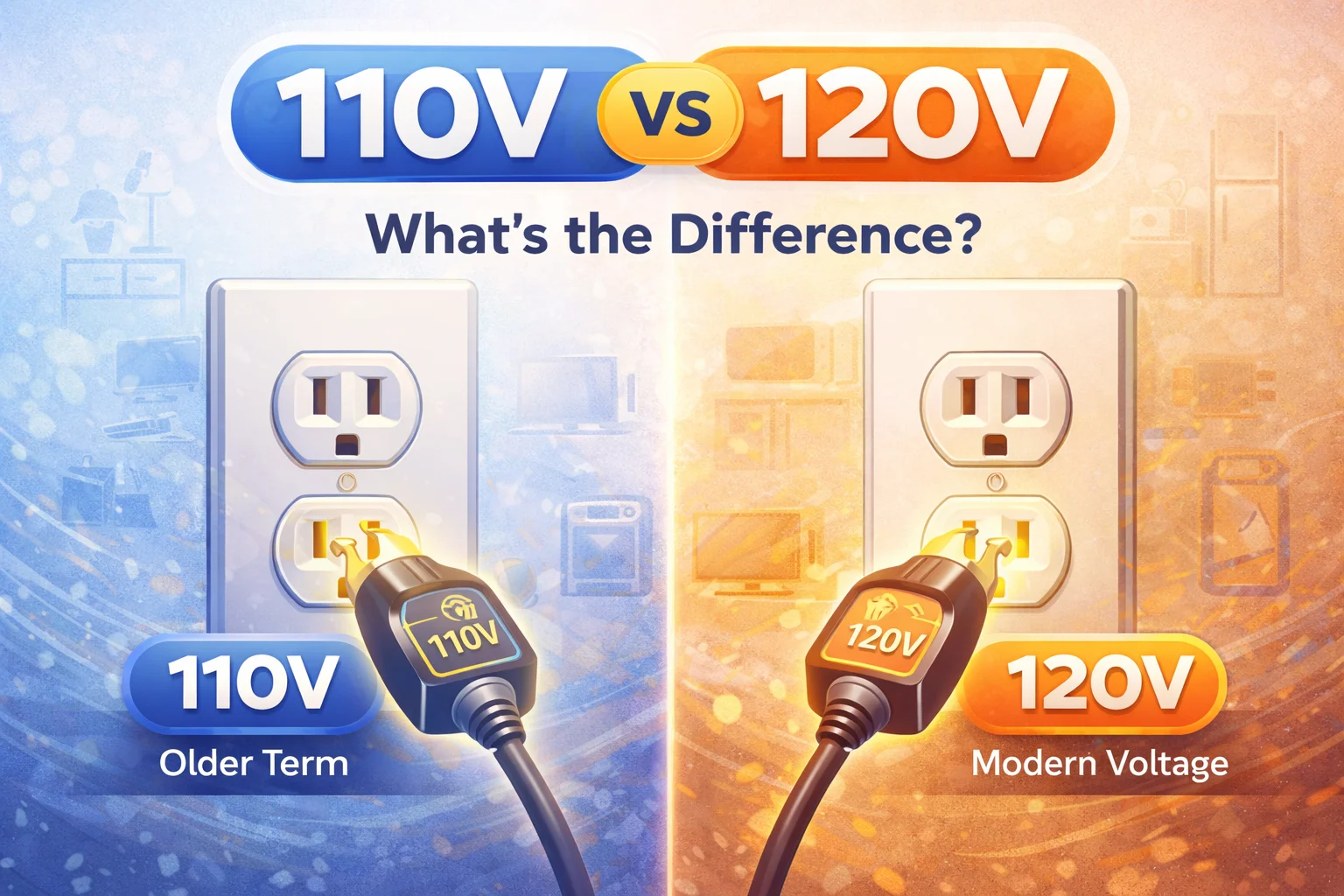
110V (110 volts) refers to an older standard of electrical voltage that was commonly used in North America decades ago.
How 110V Is Used
Today, 110V is mostly used informally. People still say:
- “This appliance runs on 110V”
- “Do you have a 110V outlet?”
However, in most modern systems, the actual voltage is slightly higher.
Where 110V Is Used
- Everyday conversation (especially in the US and Canada)
- Older electrical systems or documentation
- Informal labeling of household electricity
Examples in Sentences
- “Make sure the device supports 110V before plugging it in.”
- “He bought a 110V tool for home use.”
- “This adapter works with 110V outlets.”
Historical / Usage Note
In the early 20th century, North American homes used around 110 volts. Over time, this increased to improve efficiency, leading to today’s standard of 120 volts. Despite the change, the term 110V stuck in everyday language.
What Is “120V”?
Meaning of 120V
120V (120 volts) is the modern standard voltage for household electricity in countries like:
- United States
- Canada
- Mexico
How 120V Is Used
This is the actual voltage supplied to most homes today. It powers:
- Lights
- TVs
- Refrigerators
- Chargers and small appliances
Where 120V Is Used
- Residential electrical systems
- Appliance specifications
- Electrical codes and engineering standards
Examples in Sentences
- “This appliance is rated for 120V.”
- “Standard outlets supply 120V in the US.”
- “Make sure your device supports 120V input.”
Regional / Technical Notes
Unlike 110V, which is informal, 120V is the official and accurate term used in electrical engineering and safety regulations.
Key Differences Between 110V and 120V
Quick Summary
- 110V = older, informal term
- 120V = modern, official standard
- Both refer to the same general household voltage range
- The actual voltage in homes typically ranges from 110V to 125V
- Most devices labeled 110V will work perfectly on 120V
Comparison Table
| Feature | 110V | 120V |
|---|---|---|
| Type | Informal / outdated term | Official modern standard |
| Actual Voltage | ~110 volts (historical) | ~120 volts (current) |
| Usage | Everyday speech | Technical & official use |
| Found In | Old systems, casual talk | Modern homes & appliances |
| Accuracy | Approximate | Precise |
| Compatibility | Works with 120V systems | Standard for devices |
| Example | “110V outlet” | “120V rated appliance” |
Real-Life Conversation Examples
Dialogue 1
A: “Is this a 110V outlet?”
B: “Technically, it’s 120V—but people still say 110V.”
🎯 Lesson: 110V vs 120V is often just a difference in wording.
Dialogue 2
A: “Can I use a 110V appliance on 120V?”
B: “Yes, most are designed to handle that range.”
🎯 Lesson: Devices are built to tolerate small voltage differences.
Dialogue 3
A: “Why does my label say 120V?”
B: “Because that’s the actual standard voltage today.”
🎯 Lesson: 120V is the correct technical term.
Dialogue 4
A: “My electrician said 120V, but I always say 110V.”
B: “That’s common—it’s just old terminology.”
🎯 Lesson: Both terms refer to nearly the same system.
Dialogue 5
A: “Do I need a converter for 110V to 120V?”
B: “No, they’re compatible.”
🎯 Lesson: No converter is needed for 110V vs 120V.
When to Use 110V vs 120V
Use “110V” When:
- Speaking casually
- Referring to older terminology
- Talking in general, non-technical contexts
Examples:
- “This tool runs on 110V.”
- “We use 110V at home.”
Use “120V” When:
- Writing technical or professional content
- Reading appliance specifications
- Following electrical codes or standards
Examples:
- “The device requires 120V input.”
- “Standard outlets provide 120V.”
Simple Memory Trick
- 110V = Old way of saying it
- 120V = Official modern voltage
US vs UK Usage
- US / Canada: Use 120V (commonly called 110V informally)
- UK / Europe: Use 230V–240V systems
So, the 110V vs 120V discussion mainly applies to North America.
Fun Facts or History
1. Voltage Increased Over Time
Electric utilities increased voltage from 110V to 120V to improve efficiency and reduce energy loss over long distances.
2. Appliances Are Flexible
Most modern devices are designed to handle a range like 100V–125V, making them safe across slight variations.
Conclusion
The difference between 110V vs 120V is simpler than it seems. While 110V is an older, informal term still used in everyday conversation, 120V is the actual and official standard used in modern electrical systems.
In reality, both refer to the same general household voltage range, and most appliances are built to handle this variation safely. The key difference lies in accuracy and context—casual vs technical use.
Now that you understand 110V vs 120V, you can confidently use the right term in any situation. Next time someone mentions these two, you’ll know exactly what they mean!